INSIGHTS

Insights

Essays distributed globally via insynergy.io.

Latest

Swipe / Shift+Wheel

Beyond Visible Authority: Why AI Governance Depends on How Authority Is Designed

Beyond Visible Authority: Why AI Governance Depends on How Authority Is Designed

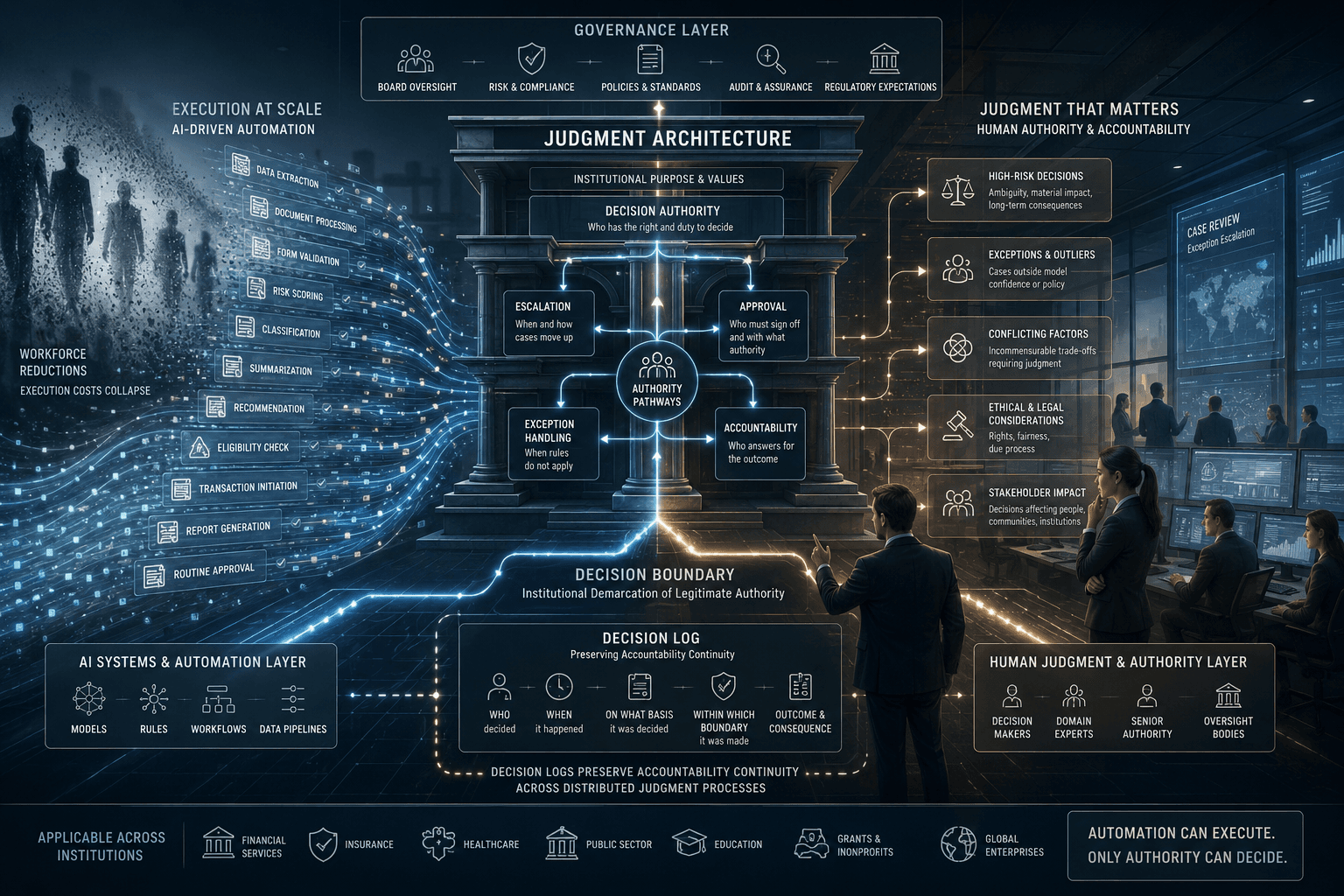
Executive visibility and visible authority are becoming central themes in AI governance. But authority alone does not explain how organizations determine who should decide, when humans must intervene, or where accountability truly resides. This article argues that the deeper challenge is not making authority visible, but designing the judgment architecture that allocates authority across humans and AI. It introduces Decision Design as a governance framework for structuring institutional judgment through Decision Boundaries and Decision Logs.

2026-06-26

Accountability Needs Authority

Accountability Needs Authority

Martin Wolf argues that humans must remain accountable for AI-driven decisions. But accountability alone cannot solve the governance challenge created by AI agents. Before organizations can assign responsibility, they must determine who was authorized to decide. This article introduces Decision Design as a judgment architecture framework for structuring authority allocation, Decision Boundaries, and accountability continuity in AI-augmented organizations.

2026-06-24

The Missing Layer in AI Governance: Decision Authority

The Missing Layer in AI Governance: Decision Authority

Organizations have spent years improving AI governance through human oversight, risk management, compliance frameworks, and visibility. Yet AI-related failures continue to occur. The reason may not be a lack of accountability, but a lack of authority design. Drawing on Stephen Vintz's Responsibility Gap framework presented at RSAC 2026, this article explores why responsibility, governance, and oversight alone are insufficient in AI-augmented organizations. As AI agents increasingly participate in operational decisions, the critical question shifts from who is responsible to who has the legitimate authority to decide. The article introduces Decision Design, a judgment architecture framework for structuring authority allocation, escalation, override, accountability continuity, and decision boundaries in human-AI systems.

2026-06-23

What Robots Are Really Learning From Us

What Robots Are Really Learning From Us

A Japan Times report on Indian workers recording first-person videos for robot training reveals a deeper reality about Physical AI. Robots are not merely learning how humans move; they are learning how humans decide. Through egocentric data, human demonstration, and large-scale data annotation, human judgment is increasingly being transformed into machine-learnable form. As Physical AI systems become more autonomous, the challenge shifts from extracting judgment to allocating it. The future of AI may depend less on model capability than on how organizations structure authority, accountability, and decision boundaries.

2026-06-18

OpenAI Is Becoming an Enterprise Company. The Harder Question Comes Next.

OpenAI Is Becoming an Enterprise Company. The Harder Question Comes Next.

OpenAI’s new Partner Network is designed to solve the deployment problem of enterprise AI through consultants, certifications, and Forward Deployed Engineers. But successful deployment creates a harder question: who holds authority when AI participates in judgment? This article argues that governance, DX, automation, and AI ethics each leave a structural gap around authority allocation. It introduces Decision Design, Decision Boundaries, Decision Logs, and Judgment Architecture as a framework for governing decision authority in AI-augmented organizations.

2026-06-16

The Anthropic Incident and the Shift from AI Safety to Authority Governance

The Anthropic Incident and the Shift from AI Safety to Authority Governance

The Anthropic incident revealed a deeper shift in AI governance. The central question is no longer whether AI models are safe, but who has the authority to authorize, restrict, or terminate their use. As governments, AI developers, and enterprises increasingly collide over control of frontier AI systems, governance is evolving from model oversight toward authority design. This article examines the emergence of Authority Governance, explores the limits of existing frameworks such as AI Governance, Automation, DX, and AI Ethics, and introduces Decision Design as a judgment architecture framework for structuring authority, accountability, and decision boundaries in AI-augmented organizations.

2026-06-13

After AI Safety Certification: Why Model Safety Does Not Solve the Authority Problem

After AI Safety Certification: Why Model Safety Does Not Solve the Authority Problem

Anthropic’s proposal for FAA-style AI regulation addresses an important question: whether advanced AI models are safe enough to deploy. But safety certification does not solve a different governance problem that emerges once AI becomes part of organizational judgment. Who holds authority? When must decisions escalate to humans? Who remains accountable? And how can authority transitions be traced across AI-augmented workflows? This article argues that safe AI models and safe judgment systems are fundamentally different governance challenges. It introduces Decision Design, Decision Boundaries, and Decision Logs as components of a judgment architecture framework for structuring authority and accountability in AI-augmented organizations.

2026-06-13

The $70,000 Employee: Why AI Waste Is an Authority Problem, Not a Cost Problem

The $70,000 Employee: Why AI Waste Is an Authority Problem, Not a Cost Problem

A $70,000 AI bill from a single employee is not primarily a cost-management problem. It is a symptom of a deeper governance failure. As organizations deploy AI agents at scale, many discover that productivity gains do not automatically translate into organizational outcomes. The missing layer is authority design: who decides, what may be delegated to AI, and how accountability is preserved. This article introduces Authority Allocation Gap, Governance Gap, Decision Boundaries, and Decision Logs as foundational concepts for understanding why AI governance requires more than automation, compliance, or ethics frameworks alone.

2026-06-09

AI Companies Have Started Asking Who Decides

AI Companies Have Started Asking Who Decides

Anthropic and OpenAI are no longer talking only about AI capability. They are increasingly talking about oversight, control, and the limits of autonomous systems. The deeper issue, however, is not whether humans remain in the loop. It is whether organizations have explicitly designed who holds legitimate judgment authority when AI participates in decision-making. As AI recommendations become more capable and more pervasive, the decision-maker risks disappearing from the process itself. This article argues that the defining challenge of enterprise AI is shifting from capability to authority, and introduces Decision Design as a framework for structuring judgment, accountability, and decision boundaries in AI-augmented organizations.

2026-06-05

Toward Decision Design: The Authority Problem in AI-Augmented Organizations

Toward Decision Design: The Authority Problem in AI-Augmented Organizations

Most large enterprises that adopted AI have reduced headcount, yet Gartner finds no correlation between those cuts and return on investment. The firms seeing real returns use AI to amplify people rather than replace them. This article argues that the failure of AI-driven layoffs is not an efficiency problem but an authority problem: organizations are removing labor while leaving judgment authority undesigned. As AI systems participate in operational decisions, the binding constraint becomes who legitimately decides, where authority resides, when decisions escalate, and who remains accountable. Governance, digital transformation, automation, and AI ethics each address part of this, but none allocates authority within AI-mediated processes. The article introduces Decision Design as a distinct institutional layer—built on Decision Boundaries, Judgment Architecture, and Decision Logs—and shows how it applies to loan approval, insurance claims, grant review, and autonomous agents.

2026-06-03

The Fourth Layer: Beyond AI, Robotics, and Supply Chains — The Coming Competition for Judgment Architecture

The Fourth Layer: Beyond AI, Robotics, and Supply Chains — The Coming Competition for Judgment Architecture

Humanoid robotics is often framed as a competition in artificial intelligence. Yet the deeper contest may lie elsewhere. Drawing on McKinsey's analysis of manufacturing, labor shortages, supply chains, and industrial scaling, this article argues that the future of humanoid robotics will be shaped not only by AI models or hardware, but by the ability of organizations to govern distributed judgment. As autonomous systems become embedded in industrial operations, questions of authority, accountability, and decision boundaries emerge as critical competitive factors. The next industrial era may ultimately belong to those who can design and govern judgment architectures at scale.

2026-06-02

Physical AI and the Judgment Layer- Why Japan's Robotics Strategy Is an Institutional Challenge, Not a Modeling One

Physical AI and the Judgment Layer- Why Japan's Robotics Strategy Is an Institutional Challenge, Not a Modeling One

At Humanoids Summit Tokyo, METI’s Toshikazu Okuya outlined Japan’s emerging Physical AI strategy—one built on industrial robotics, manufacturing expertise, Data Refinery, and Robotics Foundation Models. But beyond models and datasets lies a deeper challenge: institutional judgment. As autonomous systems move from recommendation to action, organizations must determine who decides, who intervenes, and who remains accountable. This article explores why Physical AI is ultimately not only a technological challenge, but an institutional one—and why Decision Design may become a critical governance framework for the next generation of autonomous systems.

2026-06-02

Who Decided? The Question AI Governance Keeps Avoiding

Who Decided? The Question AI Governance Keeps Avoiding

A headline warning that "AI is manipulating human decisions" aims at the wrong target. Humans have always been influenced; the novelty is not influence but structure. As AI moves into product summaries, legal research, and political information, it participates in judgments whose authority structure no one has designed. The central challenge of AI governance is therefore no longer model capability—it is authority allocation. This essay argues that Governance, DX, Automation, and AI Ethics are each necessary but insufficient, and that beneath them sits an unaddressed layer: the institutional architecture of judgment. It introduces Decision Design and its core constructs—Decision Boundaries, which mark where legitimate authority transfers, and Decision Logs, which preserve accountability across distributed decisions—with practical boundaries for grant review, AI agents, public sector workflows, and enterprise approval chains. Three failures, one question: who decided, who held authority, and who remains accountable when the decision is wrong?

2026-05-31

The Empty Chair at the Center of the Machine

The Empty Chair at the Center of the Machine

Pope Leo XIV’s warning about AI and “human dignity” is not merely a theological concern. It points to a growing structural problem inside AI-augmented institutions: humans increasingly retain responsibility while real judgment authority migrates to machines. From military targeting systems to subsidy screening, underwriting, and autonomous AI agents, “human oversight” often collapses into ritualized confirmation. This article introduces Decision Design as a missing governance layer beyond Governance, DX, Automation, and AI Ethics — a framework for intentionally designing who inherits judgment, where authority boundaries exist, and how accountability continuity is preserved in human–AI systems.

2026-05-28

When AI Enters the Law Firm, What Really Changes Is Not the Work — It Is the Judgment

When AI Enters the Law Firm, What Really Changes Is Not the Work — It Is the Judgment

AI is not simply changing legal work. It is quietly reshaping how judgment, accountability, and professional formation operate inside institutions.

2026-05-24

The Quiet Collapse of the Apprenticeship Layer

The Quiet Collapse of the Apprenticeship Layer

AI is not only replacing tasks. It may also be dissolving the apprenticeship layer through which inexperienced people once accumulated judgment and became capable decision-makers. As organizations optimize away entry-level cognitive work, a deeper structural question emerges: who will produce the next generation of human judgment?

2026-05-22

When Nobody Actually Decided: Judgment Authority in AI-Augmented Organizations

When Nobody Actually Decided: Judgment Authority in AI-Augmented Organizations

AI governance is no longer just a problem of managing tools. As AI agents reshape workflows, organizations are beginning to lose clarity over who actually exercises judgment authority. This article explores why Human-in-the-Loop structures often collapse into procedural legitimacy, why governance and automation frameworks leave a structural gap, and why AI-augmented organizations must begin designing authority itself through Decision Design, Decision Boundaries, and Decision Logs.

2026-05-21

The Real Problem Is Not Whether AI Was Used — It Is Who Owns the Judgment

The Real Problem Is Not Whether AI Was Used — It Is Who Owns the Judgment

As organizations become obsessed with detecting AI-generated work, they risk overlooking the deeper problem emerging beneath AI adoption: the erosion of clear judgment ownership. This article argues that the real issue is not whether AI was used, but who ultimately owns the authority, responsibility, and legitimacy behind a decision. From Human-in-the-Loop rituals to AI-generated business proposals and large-scale creative production like manga and animation, the piece explores why authorship has never been about manual production alone. It introduces Decision Design, Decision Boundaries, and Decision Logs as institutional concepts for structuring accountability in AI-augmented systems.

2026-05-19

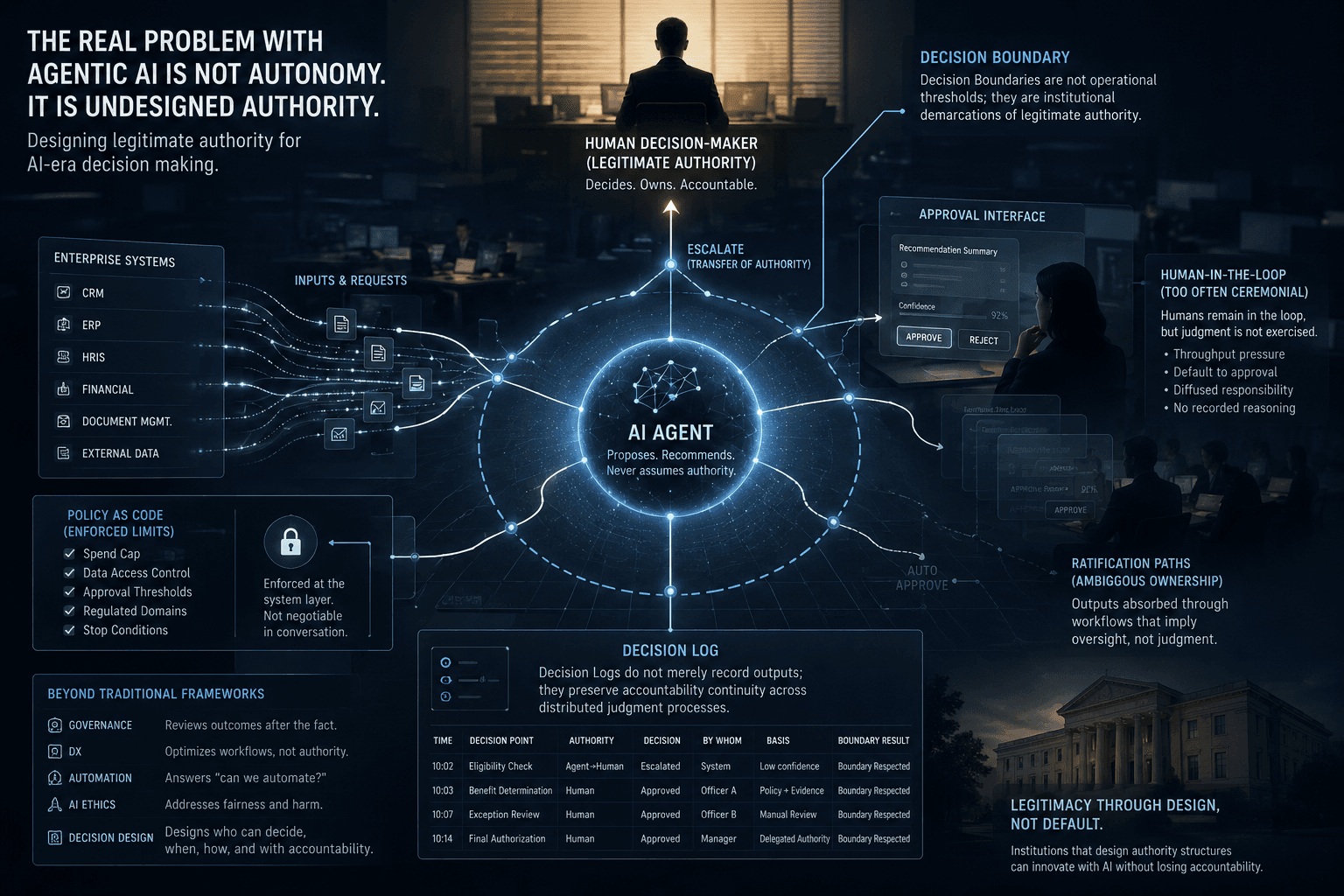
The Real Problem With Agentic AI Is Not Autonomy. It Is Undesigned Authority.

The Real Problem With Agentic AI Is Not Autonomy. It Is Undesigned Authority.

Most discussions about agentic AI focus on autonomy, hallucinations, or guardrails. But the deeper problem is institutional: organizations have never explicitly designed how judgment becomes legitimate. Using Anthropic’s Project Vend, enterprise AI workflows, and public-sector review systems as examples, this essay introduces Decision Design, Decision Boundaries, and Decision Logs as a missing architectural layer for AI-era governance.

2026-05-15

Who Holds Judgment? Decision Design in the Age of the One-Person Firm

Who Holds Judgment? Decision Design in the Age of the One-Person Firm

As AI agents increasingly execute work before humans review it, enterprises are drifting toward “ceremonial approval” — a condition where procedural oversight survives but substantive judgment disappears. This article argues that the real challenge of AI adoption is no longer automation itself, but the design of institutional judgment authority. Introducing Decision Design, Decision Boundaries, and Decision Logs as a governance architecture for AI-mediated organizations.

2026-05-12

Generative AI and the Limits of Rights Doctrine: Why Japan's Ministry of Justice Is Really Asking a Question About Judgment Design

Generative AI and the Limits of Rights Doctrine: Why Japan's Ministry of Justice Is Really Asking a Question About Judgment Design

Japan’s Ministry of Justice may appear to be clarifying generative AI rights doctrine. The deeper issue, however, is judgment design: who decides, where authority shifts back from AI to humans, and how accountability is preserved across distributed review processes.

2026-04-17

The Real Risk of AI-Driven Development Is Not Bad Code. It Is Undesigned Judgment.

The Real Risk of AI-Driven Development Is Not Bad Code. It Is Undesigned Judgment.

AI-driven development is accelerating software delivery, but it is also exposing a deeper structural risk: the absence of designed judgment. This article argues that issues such as vulnerabilities, OSS license violations, and data leakage are not isolated technical failures, but symptoms of a missing accountability architecture. By introducing Decision Design, Decision Boundaries, and Decision Logs, it reframes AI governance as a problem of institutional authority, not just tool adoption.

2026-04-11

Beyond Human-in-the-Loop: Why AI Governance Requires Judgment Architecture

Beyond Human-in-the-Loop: Why AI Governance Requires Judgment Architecture

Japan’s move to require human judgment in autonomous AI systems marks an important policy shift. But human presence alone does not solve the governance problem. The real issue is how judgment authority is structured, transferred, and made accountable across human–AI systems. This article argues that AI governance now requires Judgment Architecture: Decision Design, Decision Boundaries, and Decision Logs.

2026-03-31
"Human in the Loop" Is Not a Governance Answer

"Human in the Loop" Is Not a Governance Answer

As governments move to require human judgment in AI agent deployments, the real governance challenge is not human presence alone, but the design of legitimate authority. This article introduces Decision Design, Decision Boundaries, and Decision Logs as the institutional architecture needed to govern autonomous AI systems with accountability continuity.

2026-03-13

When AI Moves Closer to Judgment: The Boundary Problem Banks Are Not Designing For

When AI Moves Closer to Judgment: The Boundary Problem Banks Are Not Designing For

Chiba Bank's plan to deploy AI across work equivalent to 2,000 employees raises a question that goes beyond productivity: what kind of work is AI being moved into? When AI is positioned near evaluation, screening, audit, or risk assessment, the real issue is not capability—it is whether institutions have designed where human judgment must remain, and who bears responsibility when outputs are wrong.

2026-03-12

What Salesforce Didn't Say: The Interface Has Changed, and So Has the Problem

What Salesforce Didn't Say: The Interface Has Changed, and So Has the Problem

A measured defense of SaaS misses the deeper shift underway: in the AI agent era, the interface is no longer just a display layer. It is becoming the operational surface where delegation, confirmation, interruption, and accountability are structured. The real issue is not whether SaaS survives, but how enterprise systems design judgment through Decision Boundary (organizational governance), Human Judgment Decision Boundary, and Governance Decision Boundary.

2026-03-11

When AI "Judges" and RPA Executes: Who Actually Draws the Line?

When AI "Judges" and RPA Executes: Who Actually Draws the Line?

As generative AI begins to function as judgment and RPA turns that output into action, the real issue is no longer automation alone but where organizations draw the Decision Boundary between AI output, human judgment, and formal governance accountability.

2026-03-10

Beyond Risk and Literacy: Why AI Governance Needs Judgment Architecture

Beyond Risk and Literacy: Why AI Governance Needs Judgment Architecture

AI governance does not become a competitive advantage through risk analysis or workforce literacy alone. The missing layer is judgment architecture: designing where AI delegation ends, where accountable human judgment begins, and where governance must formally intervene.

2026-03-09

AI Agent Liability Is the Wrong Debate — The Real Problem Is Decision Architecture

AI Agent Liability Is the Wrong Debate — The Real Problem Is Decision Architecture

As AI agents begin making operational decisions in finance, hiring, healthcare, and infrastructure, the global governance debate has focused on liability — who is responsible when AI causes harm. But liability frameworks operate after the fact. They assign consequences once damage has already occurred. The deeper issue lies earlier: how decisions are structured before AI systems are deployed. This article introduces the concept of Decision Design — the deliberate architecture of organizational decision-making in human-AI systems. It explains how three boundaries shape accountable AI governance: the Decision Boundary (organizational governance), the Human Judgment Decision Boundary, and the Governance Decision Boundary. Without explicitly designing these boundaries, organizations risk creating systems where AI influence expands silently while human accountability becomes purely formal.

2026-03-09

The Better the Output Looks, the Less We Question It

The Better the Output Looks, the Less We Question It

Polished AI outputs do not simply improve productivity. They also reduce human scrutiny. Drawing on Anthropic’s AI Fluency Index, this article argues that AI discernment should not be treated as a talent problem, but as a judgment architecture and governance design problem.

2026-03-08

When AI Output Becomes Advice: The Nippon Life vs. OpenAI Case and the Governance Gap It Exposes

When AI Output Becomes Advice: The Nippon Life vs. OpenAI Case and the Governance Gap It Exposes

The Nippon Life vs. OpenAI lawsuit highlights a structural governance gap: when AI output functions as advice but no accountable advisor exists. This article examines why the issue is not model accuracy, but the absence of designed judgment boundaries, authority structures, and accountability connections in AI deployment.

2026-03-06

AI Does Not Reduce Work. It Intensifies It—Because Nobody Has Designed the Handoff.

AI Does Not Reduce Work. It Intensifies It—Because Nobody Has Designed the Handoff.

AI often speeds up first-pass generation without reducing total work. Review, correction, approval, and accountability still remain human. The real issue is not AI usage alone, but the absence of a clear decision boundary defining where AI stops and human judgment begins.

2026-03-06

Can Japan's Government Turn AI Into Delivery Power?

Can Japan's Government Turn AI Into Delivery Power?

When governments deploy AI, the question is not merely adoption—it is accountability. As Japan’s Digital Agency and Tokyo Metropolitan Government scale their Government AI platform “Gennai,” a deeper design challenge emerges: who decides, and where does responsibility reside? From formal screening to substantive review to final human decision, public-sector AI reveals a structural tension between speed and judgment. This article explores how “delivery power” reshapes governance—and why the true frontier of AI implementation lies in designing the Decision Boundary (organizational governance). Beyond experimentation, 2026 marks the shift from AI pilots to measurable outcomes. The real question is no longer whether AI works, but how Human Judgment Decision Boundary and Governance Decision Boundary must be architected to sustain trust.

2026-03-03

Trust in Physical AI Cannot Be Declared. It Must Be Architected.

Trust in Physical AI Cannot Be Declared. It Must Be Architected.

Physical AI is forcing executives to rethink what trust means in operational systems. As AI moves into vehicles, factories, warehouses, and infrastructure, performance is no longer enough. What matters is whether decision authority, accountability, and governance structures are explicitly designed. This article argues that AI risk does not primarily emerge inside models, but at organizational and operational interfaces where responsibility is unclear. It introduces the concept of the Decision Boundary (organizational governance) as the structural definition of where AI autonomy ends and accountable human authority begins. By distinguishing Human Judgment Decision Boundary and Governance Decision Boundary, the piece reframes AI trust as an architectural problem of decision structure design rather than compliance or ethics alone. In physical AI, trust cannot be declared. It must be engineered through deliberate boundary design, accountability allocation, and lifecycle governance.

2026-03-02

Human Oversight Is Not Enough — The Real Problem Is the Decision Boundary

Human Oversight Is Not Enough — The Real Problem Is the Decision Boundary

Building on Alex “Sandy” Pentland’s argument that AI requires human oversight due to its reliance on backward-looking data, this article argues that oversight alone is not governance. The real issue is the absence of a clearly defined Decision Boundary (organizational governance). Introducing the Human Judgment Decision Boundary and the Governance Decision Boundary, it presents a practical three-layer architecture — Proposal, Approval, Accountability — with re-evaluation triggers and escalation logic under uncertainty. This framework shifts AI governance from symbolic human involvement to structured decision authority design.

2026-03-01

After Risk Mapping, What Gets Designed? Decision Boundary (Organizational Governance) as the Next Layer for Agentic AI

After Risk Mapping, What Gets Designed? Decision Boundary (Organizational Governance) as the Next Layer for Agentic AI

UC Berkeley’s “Agentic AI Risk-Management Standards Profile” marks a pivotal shift in AI governance — from model-level evaluation to system-level risk mapping. It identifies cascading failures, accountability diffusion, and goal drift as structural risks unique to autonomous AI agents. Yet risk mapping alone does not determine how organizations allocate judgment authority between humans and AI. This article introduces Decision Boundary (organizational governance) as the next governance layer. While risk frameworks manage consequences, Decision Boundary designs authority — specifying who decides what, under which conditions, and through what accountability structure. By distinguishing Human-in-the-loop from Human Judgment Decision Boundary and Governance Decision Boundary, this essay reframes AI governance as an architectural problem rather than a compliance exercise. The future of agentic AI governance depends not only on managing risks, but on deliberately designing the boundaries of organizational judgment.

2026-02-28

Who Actually Decides?

Who Actually Decides?

AI adoption is accelerating across organizations, but few are asking a more fundamental question: who actually decides? As AI drafts strategy, evaluates risk, and generates recommendations, decision authority can quietly shift. The issue is not human cognitive decline, but positional displacement — a movement of the “seat of judgment” from human actors to AI-generated reasoning. Regulators increasingly mandate human oversight, yet they cannot specify where the boundary between AI contribution and human judgment should lie. That design responsibility falls to organizations themselves. This article introduces Decision Design and the concept of a Decision Boundary — a structured approach to defining where AI ends and human accountability begins. In the AI era, clarity about that line is not a philosophical concern. It is an architectural one.

2026-02-27

Can AI Truly Prevent Financial Crime?

Can AI Truly Prevent Financial Crime?

As banks accelerate AI adoption in KYC, AML, and transaction monitoring, a deeper structural question emerges: can AI truly prevent financial crime? While AI significantly enhances detection capabilities, it cannot assume judgment. This article explores the distinction between detection and decision-making, the structural limits of AI in handling first-time offenders and synthetic identities, and why financial institutions must deliberately design the boundary between automated systems and human responsibility. Introducing the concept of Decision Design and Decision Boundary, the piece argues that the future of AI governance is not about better models—but about consciously architecting who decides, under what conditions, and where accountability resides.

2026-02-27

AI Agents Don't Eliminate Decisions. They Expose the Absence of Decision Design.

AI Agents Don't Eliminate Decisions. They Expose the Absence of Decision Design.

AI agents are often celebrated for accelerating workflows and reducing costs. But speed is not the structural issue. As organizations deploy increasingly autonomous systems, a deeper problem emerges: decision authority, responsibility, and auditability were rarely designed in the first place. Drawing on recent enterprise cases in manufacturing and procurement, this article argues that the real challenge of agentic AI is not automation, but the architectural void where accountability should exist. Process modeling tools can allocate tasks. They do not define who owns a decision. As regulators worldwide emphasize human oversight requirements, organizations must move beyond workflow optimization and deliberately design decision structures. The article introduces Decision Design and Decision Boundary Mapping as practical frameworks for clarifying authority, assigning responsibility, and ensuring auditability at the human–AI boundary. AI agents do not eliminate decisions. They expose the absence of decision architecture.

2026-02-26

If the Work Takes 10 Minutes, Why Do You Still Need a Human?

If the Work Takes 10 Minutes, Why Do You Still Need a Human?

Novo Nordisk reduced the production time of clinical study reports from over ten weeks to ten minutes using AI. Yet the compression of drafting did not eliminate human responsibility. The AI writes. Humans review, evaluate, and sign. As agentic systems like Claude Cowork extend AI execution across enterprise knowledge work, the central question shifts from capability to accountability: when AI executes, who owns the judgment? This article examines the structural distinction between task automation and judgment relocation. Drawing from pharmaceutical regulation, the EU AI Act, and emerging global oversight requirements, it argues that organizations must deliberately design the boundary between AI execution and human authority. The concept of Decision Design introduces judgment itself as an object of organizational design. Its core structural element — the Decision Boundary — defines where delegation ends and responsibility begins. Speed increased. Judgment did not disappear.

2026-02-26

When Agents Act, Who Decided?

When Agents Act, Who Decided?

AI agents can automate workflows—but they also dissolve the accountability infrastructure SaaS quietly provided: identity, audit trails, and decision attribution. As “shadow agents” spread and agent counts reach workforce scale, “human-in-the-loop” stops scaling. This essay introduces Decision Design and the Decision Boundary as a practical way to make judgment ownership explicit, visible, and maintainable—before governance becomes performative.

2026-02-26

The Real Problem With Military AI Isn't Ethics. It's Boundary Design.

The Real Problem With Military AI Isn't Ethics. It's Boundary Design.

The conflict between the U.S. Department of Defense and Anthropic is often framed as an ethics debate. It is not. This article argues that the real issue is the absence of a shared architecture for allocating judgment authority between states, AI providers, and autonomous systems. Introducing the concept of Decision Design, it proposes practical frameworks — including a Tri-Layer Decision Model and a Decision Ledger — for structuring responsibility in military AI deployment.

2026-02-25

Is Back-Office Automation Really About Automation?

Is Back-Office Automation Really About Automation?

AI approving expense reports appears to be a story of efficiency. But beneath the surface, something more structural is happening. When organizations convert internal policies into machine-readable formats and delegate approval authority to AI, they are not merely automating tasks — they are transferring judgment. This article argues that existing frameworks — Governance, Digital Transformation, Automation, and AI Ethics — are necessary but insufficient to address the architectural implications of AI-driven decision delegation. Introducing Decision Design and Decision Boundary as the missing design layer, the piece outlines the structural risks of judgment compression, responsibility dilution, capability erosion, and boundary drift — and proposes a three-layer implementation model for sustainable AI-native enterprises.

2026-02-24

Why AI Agents Fail in Practice — And Why Architecture Alone Won't Fix It

Why AI Agents Fail in Practice — And Why Architecture Alone Won't Fix It

AI agent failures in enterprise workflows are often described as architecture problems. Missing constraints, weak validation layers, limited observability, and poorly designed escalation paths are frequently cited as root causes. But beneath these architectural gaps lies a deeper structural issue: the absence of designed judgment. This article argues that AI agent breakdowns are not primarily model failures nor purely infrastructure deficiencies. They are symptoms of an undefined decision structure — where authority, delegation, and accountability boundaries between AI and humans remain implicit. Introducing the concepts of Decision Design and Decision Boundary, this analysis reframes AI agent failure as an organizational design challenge. It also outlines a practical framework for specifying non-decision conditions, escalation thresholds, decision ledgers, and responsibility transfer protocols. Architecture matters. But without deliberate judgment design, architecture alone will not prevent failure.

2026-02-24

When Intelligence Becomes Abundant, Judgment Must Be Designed

When Intelligence Becomes Abundant, Judgment Must Be Designed

As AI systems compress cognition and accelerate output generation, the bottleneck in modern institutions shifts from information access to judgment allocation. In response to Craig Mundie’s call for educational reform in the AI era, this essay reframes the debate: the central issue is not curriculum redesign, but structural responsibility design. Introducing Decision Design, a framework for intentionally allocating judgment authority in AI-augmented environments, this article argues that institutions must explicitly define where AI authority ends and human authority begins. Through the concept of Decision Boundary, it proposes operational methods for preventing unconscious delegation and accountability drift. Education becomes the earliest test case—but the implications extend far beyond it. When intelligence becomes abundant, judgment must be designed.

2026-02-24

When Intelligence Becomes Abundant, What Becomes Scarce?

When Intelligence Becomes Abundant, What Becomes Scarce?

As AI systems accelerate and claims of superintelligence grow louder, a deeper question emerges: what exactly does it mean for AI to “outperform” a CEO? This article separates computation from judgment and argues that executive decision-making is not merely an optimization problem. While AI can process information, simulate outcomes, and recommend actions at unprecedented scale, governance requires something fundamentally different: accountable commitment. The real risk is not that AI becomes smarter than executives, but that organizations allow decision-making to hollow out—where AI outputs are executed without a clearly designated human agent assuming responsibility. To address this structural risk, the article introduces Decision Design and the concept of the Decision Boundary: the intentional architectural demarcation between AI contribution and human accountability. As intelligence becomes abundant, judgment—and its governance—may become the scarce resource organizations must deliberately protect.

2026-02-23

What "50% of Tasks Can Be Automated" Fails to Measure

What "50% of Tasks Can Be Automated" Fails to Measure

Anthropic’s Economic Index suggests that nearly 50% of tasks performed with Claude are automation-oriented and that AI could raise U.S. labor productivity by 1.8 percentage points annually. These figures are compelling—but they describe AI capability, not organizational structure. This essay argues that automation metrics fail to capture second-order effects: Decision Compression (the quiet migration of judgment into AI systems), the breakdown of training pathways for junior professionals, and the erosion of accountability when human approval becomes procedural rather than substantive. The real question is not how much AI can automate, but where the boundary between human and AI judgment should be drawn—and who designs it. Introducing Decision Design: a framework for intentionally structuring judgment, responsibility, and learning in AI-native organizations.

2026-02-22

AI Literacy Is Now a Job Requirement in VC. But the Real Question Is Being Missed.

AI Literacy Is Now a Job Requirement in VC. But the Real Question Is Being Missed.

Venture capital firms are making AI literacy a formal hiring requirement. But the real issue is not whether professionals can use AI tools — it is whether organizations have designed how AI-informed decisions are made. Bloomberg reports that VCs evaluate candidates on their ability to select tools, prompt effectively, and integrate AI outputs into judgment. Yet the most critical layer — integration — lacks any formal structure. If AI shapes the informational foundation of decisions, then maintaining human agency requires more than a “human-in-the-loop” claim. It requires an explicit design of the decision boundary. This essay introduces Decision Design — a methodology for structuring how judgment is made in AI-mediated environments — and proposes practical mechanisms such as the Judgment Ledger to restore accountability, verifiability, and durable human agency.

2026-02-22

The Undesigned Decision: Why AI Agents Expose a Governance Void, Not a Security Flaw

The Undesigned Decision: Why AI Agents Expose a Governance Void, Not a Security Flaw

The 2025 AI Agent Index published through MIT CSAIL reveals a structural governance gap in deployed AI agents. Across 30 prominent systems, researchers found widespread deficiencies in safety disclosure, execution traceability, identity transparency, and third-party evaluation. Yet the deeper issue is not cybersecurity. Security assumes defined boundaries. The more fundamental problem is that most enterprise AI agents operate without explicitly designed decision scope, authorization limits, or structured accountability. This essay argues that the real governance failure is architectural: organizations are deploying judgment-bearing systems without designing the boundaries of what those systems are authorized to decide. Introducing Decision Design and the concept of the Decision Boundary, the article outlines how enterprises can move from reactive security posture to structured judgment governance, including a practical implementation model—the Agent Decision Ledger.

2026-02-21

AI Isn't Eliminating Jobs. It's Revealing Who Forgot to Design the Decisions.

AI Isn't Eliminating Jobs. It's Revealing Who Forgot to Design the Decisions.

AI is widely portrayed as the direct cause of an impending wave of white-collar layoffs. But the causal chain is far less straightforward than headlines suggest. Productivity gains remain uneven and difficult to measure, while recent workforce reductions correlate more strongly with post-pandemic overcorrection and capital market pressure than with AI-driven surplus. The deeper issue is not technological capability, but decision architecture. When companies attribute restructuring to “AI efficiency,” responsibility can become obscured. This article examines how organizations can redesign their decision structures—through Decision Design and explicit Decision Boundaries—to ensure accountability remains human, even in AI-augmented environments.

2026-02-21

All

Beyond Visible Authority: Why AI Governance Depends on How Authority Is Designed

Executive visibility and visible authority are becoming central themes in AI governance. But authority alone does not explain how organizations determine who should decide, when humans must intervene, or where accountability truly resides. This article argues that the deeper challenge is not making authority visible, but designing the judgment architecture that allocates authority across humans and AI. It introduces Decision Design as a governance framework for structuring institutional judgment through Decision Boundaries and Decision Logs.

The Missing Layer in AI Governance: Decision Authority

Organizations have spent years improving AI governance through human oversight, risk management, compliance frameworks, and visibility. Yet AI-related failures continue to occur. The reason may not be a lack of accountability, but a lack of authority design. Drawing on Stephen Vintz's Responsibility Gap framework presented at RSAC 2026, this article explores why responsibility, governance, and oversight alone are insufficient in AI-augmented organizations. As AI agents increasingly participate in operational decisions, the critical question shifts from who is responsible to who has the legitimate authority to decide. The article introduces Decision Design, a judgment architecture framework for structuring authority allocation, escalation, override, accountability continuity, and decision boundaries in human-AI systems.

What Robots Are Really Learning From Us

A Japan Times report on Indian workers recording first-person videos for robot training reveals a deeper reality about Physical AI. Robots are not merely learning how humans move; they are learning how humans decide. Through egocentric data, human demonstration, and large-scale data annotation, human judgment is increasingly being transformed into machine-learnable form. As Physical AI systems become more autonomous, the challenge shifts from extracting judgment to allocating it. The future of AI may depend less on model capability than on how organizations structure authority, accountability, and decision boundaries.

OpenAI Is Becoming an Enterprise Company. The Harder Question Comes Next.

OpenAI’s new Partner Network is designed to solve the deployment problem of enterprise AI through consultants, certifications, and Forward Deployed Engineers. But successful deployment creates a harder question: who holds authority when AI participates in judgment? This article argues that governance, DX, automation, and AI ethics each leave a structural gap around authority allocation. It introduces Decision Design, Decision Boundaries, Decision Logs, and Judgment Architecture as a framework for governing decision authority in AI-augmented organizations.

The Anthropic Incident and the Shift from AI Safety to Authority Governance

The Anthropic incident revealed a deeper shift in AI governance. The central question is no longer whether AI models are safe, but who has the authority to authorize, restrict, or terminate their use. As governments, AI developers, and enterprises increasingly collide over control of frontier AI systems, governance is evolving from model oversight toward authority design. This article examines the emergence of Authority Governance, explores the limits of existing frameworks such as AI Governance, Automation, DX, and AI Ethics, and introduces Decision Design as a judgment architecture framework for structuring authority, accountability, and decision boundaries in AI-augmented organizations.

After AI Safety Certification: Why Model Safety Does Not Solve the Authority Problem

Anthropic’s proposal for FAA-style AI regulation addresses an important question: whether advanced AI models are safe enough to deploy. But safety certification does not solve a different governance problem that emerges once AI becomes part of organizational judgment. Who holds authority? When must decisions escalate to humans? Who remains accountable? And how can authority transitions be traced across AI-augmented workflows? This article argues that safe AI models and safe judgment systems are fundamentally different governance challenges. It introduces Decision Design, Decision Boundaries, and Decision Logs as components of a judgment architecture framework for structuring authority and accountability in AI-augmented organizations.

The $70,000 Employee: Why AI Waste Is an Authority Problem, Not a Cost Problem

A $70,000 AI bill from a single employee is not primarily a cost-management problem. It is a symptom of a deeper governance failure. As organizations deploy AI agents at scale, many discover that productivity gains do not automatically translate into organizational outcomes. The missing layer is authority design: who decides, what may be delegated to AI, and how accountability is preserved. This article introduces Authority Allocation Gap, Governance Gap, Decision Boundaries, and Decision Logs as foundational concepts for understanding why AI governance requires more than automation, compliance, or ethics frameworks alone.

AI Companies Have Started Asking Who Decides

Anthropic and OpenAI are no longer talking only about AI capability. They are increasingly talking about oversight, control, and the limits of autonomous systems. The deeper issue, however, is not whether humans remain in the loop. It is whether organizations have explicitly designed who holds legitimate judgment authority when AI participates in decision-making. As AI recommendations become more capable and more pervasive, the decision-maker risks disappearing from the process itself. This article argues that the defining challenge of enterprise AI is shifting from capability to authority, and introduces Decision Design as a framework for structuring judgment, accountability, and decision boundaries in AI-augmented organizations.

Toward Decision Design: The Authority Problem in AI-Augmented Organizations

Most large enterprises that adopted AI have reduced headcount, yet Gartner finds no correlation between those cuts and return on investment. The firms seeing real returns use AI to amplify people rather than replace them. This article argues that the failure of AI-driven layoffs is not an efficiency problem but an authority problem: organizations are removing labor while leaving judgment authority undesigned. As AI systems participate in operational decisions, the binding constraint becomes who legitimately decides, where authority resides, when decisions escalate, and who remains accountable. Governance, digital transformation, automation, and AI ethics each address part of this, but none allocates authority within AI-mediated processes. The article introduces Decision Design as a distinct institutional layer—built on Decision Boundaries, Judgment Architecture, and Decision Logs—and shows how it applies to loan approval, insurance claims, grant review, and autonomous agents.

The Fourth Layer: Beyond AI, Robotics, and Supply Chains — The Coming Competition for Judgment Architecture

Humanoid robotics is often framed as a competition in artificial intelligence. Yet the deeper contest may lie elsewhere. Drawing on McKinsey's analysis of manufacturing, labor shortages, supply chains, and industrial scaling, this article argues that the future of humanoid robotics will be shaped not only by AI models or hardware, but by the ability of organizations to govern distributed judgment. As autonomous systems become embedded in industrial operations, questions of authority, accountability, and decision boundaries emerge as critical competitive factors. The next industrial era may ultimately belong to those who can design and govern judgment architectures at scale.

Physical AI and the Judgment Layer- Why Japan's Robotics Strategy Is an Institutional Challenge, Not a Modeling One

At Humanoids Summit Tokyo, METI’s Toshikazu Okuya outlined Japan’s emerging Physical AI strategy—one built on industrial robotics, manufacturing expertise, Data Refinery, and Robotics Foundation Models. But beyond models and datasets lies a deeper challenge: institutional judgment. As autonomous systems move from recommendation to action, organizations must determine who decides, who intervenes, and who remains accountable. This article explores why Physical AI is ultimately not only a technological challenge, but an institutional one—and why Decision Design may become a critical governance framework for the next generation of autonomous systems.

Who Decided? The Question AI Governance Keeps Avoiding

A headline warning that "AI is manipulating human decisions" aims at the wrong target. Humans have always been influenced; the novelty is not influence but structure. As AI moves into product summaries, legal research, and political information, it participates in judgments whose authority structure no one has designed. The central challenge of AI governance is therefore no longer model capability—it is authority allocation. This essay argues that Governance, DX, Automation, and AI Ethics are each necessary but insufficient, and that beneath them sits an unaddressed layer: the institutional architecture of judgment. It introduces Decision Design and its core constructs—Decision Boundaries, which mark where legitimate authority transfers, and Decision Logs, which preserve accountability across distributed decisions—with practical boundaries for grant review, AI agents, public sector workflows, and enterprise approval chains. Three failures, one question: who decided, who held authority, and who remains accountable when the decision is wrong?

The Empty Chair at the Center of the Machine

Pope Leo XIV’s warning about AI and “human dignity” is not merely a theological concern. It points to a growing structural problem inside AI-augmented institutions: humans increasingly retain responsibility while real judgment authority migrates to machines. From military targeting systems to subsidy screening, underwriting, and autonomous AI agents, “human oversight” often collapses into ritualized confirmation. This article introduces Decision Design as a missing governance layer beyond Governance, DX, Automation, and AI Ethics — a framework for intentionally designing who inherits judgment, where authority boundaries exist, and how accountability continuity is preserved in human–AI systems.

When Nobody Actually Decided: Judgment Authority in AI-Augmented Organizations

AI governance is no longer just a problem of managing tools. As AI agents reshape workflows, organizations are beginning to lose clarity over who actually exercises judgment authority. This article explores why Human-in-the-Loop structures often collapse into procedural legitimacy, why governance and automation frameworks leave a structural gap, and why AI-augmented organizations must begin designing authority itself through Decision Design, Decision Boundaries, and Decision Logs.

The Real Problem Is Not Whether AI Was Used — It Is Who Owns the Judgment

As organizations become obsessed with detecting AI-generated work, they risk overlooking the deeper problem emerging beneath AI adoption: the erosion of clear judgment ownership. This article argues that the real issue is not whether AI was used, but who ultimately owns the authority, responsibility, and legitimacy behind a decision. From Human-in-the-Loop rituals to AI-generated business proposals and large-scale creative production like manga and animation, the piece explores why authorship has never been about manual production alone. It introduces Decision Design, Decision Boundaries, and Decision Logs as institutional concepts for structuring accountability in AI-augmented systems.

The Real Problem With Agentic AI Is Not Autonomy. It Is Undesigned Authority.

Most discussions about agentic AI focus on autonomy, hallucinations, or guardrails. But the deeper problem is institutional: organizations have never explicitly designed how judgment becomes legitimate. Using Anthropic’s Project Vend, enterprise AI workflows, and public-sector review systems as examples, this essay introduces Decision Design, Decision Boundaries, and Decision Logs as a missing architectural layer for AI-era governance.

Who Holds Judgment? Decision Design in the Age of the One-Person Firm

As AI agents increasingly execute work before humans review it, enterprises are drifting toward “ceremonial approval” — a condition where procedural oversight survives but substantive judgment disappears. This article argues that the real challenge of AI adoption is no longer automation itself, but the design of institutional judgment authority. Introducing Decision Design, Decision Boundaries, and Decision Logs as a governance architecture for AI-mediated organizations.

The Real Risk of AI-Driven Development Is Not Bad Code. It Is Undesigned Judgment.

AI-driven development is accelerating software delivery, but it is also exposing a deeper structural risk: the absence of designed judgment. This article argues that issues such as vulnerabilities, OSS license violations, and data leakage are not isolated technical failures, but symptoms of a missing accountability architecture. By introducing Decision Design, Decision Boundaries, and Decision Logs, it reframes AI governance as a problem of institutional authority, not just tool adoption.

What Salesforce Didn't Say: The Interface Has Changed, and So Has the Problem

A measured defense of SaaS misses the deeper shift underway: in the AI agent era, the interface is no longer just a display layer. It is becoming the operational surface where delegation, confirmation, interruption, and accountability are structured. The real issue is not whether SaaS survives, but how enterprise systems design judgment through Decision Boundary (organizational governance), Human Judgment Decision Boundary, and Governance Decision Boundary.

AI Agent Liability Is the Wrong Debate — The Real Problem Is Decision Architecture

As AI agents begin making operational decisions in finance, hiring, healthcare, and infrastructure, the global governance debate has focused on liability — who is responsible when AI causes harm. But liability frameworks operate after the fact. They assign consequences once damage has already occurred. The deeper issue lies earlier: how decisions are structured before AI systems are deployed. This article introduces the concept of Decision Design — the deliberate architecture of organizational decision-making in human-AI systems. It explains how three boundaries shape accountable AI governance: the Decision Boundary (organizational governance), the Human Judgment Decision Boundary, and the Governance Decision Boundary. Without explicitly designing these boundaries, organizations risk creating systems where AI influence expands silently while human accountability becomes purely formal.

Can Japan's Government Turn AI Into Delivery Power?

When governments deploy AI, the question is not merely adoption—it is accountability. As Japan’s Digital Agency and Tokyo Metropolitan Government scale their Government AI platform “Gennai,” a deeper design challenge emerges: who decides, and where does responsibility reside? From formal screening to substantive review to final human decision, public-sector AI reveals a structural tension between speed and judgment. This article explores how “delivery power” reshapes governance—and why the true frontier of AI implementation lies in designing the Decision Boundary (organizational governance). Beyond experimentation, 2026 marks the shift from AI pilots to measurable outcomes. The real question is no longer whether AI works, but how Human Judgment Decision Boundary and Governance Decision Boundary must be architected to sustain trust.

Trust in Physical AI Cannot Be Declared. It Must Be Architected.

Physical AI is forcing executives to rethink what trust means in operational systems. As AI moves into vehicles, factories, warehouses, and infrastructure, performance is no longer enough. What matters is whether decision authority, accountability, and governance structures are explicitly designed. This article argues that AI risk does not primarily emerge inside models, but at organizational and operational interfaces where responsibility is unclear. It introduces the concept of the Decision Boundary (organizational governance) as the structural definition of where AI autonomy ends and accountable human authority begins. By distinguishing Human Judgment Decision Boundary and Governance Decision Boundary, the piece reframes AI trust as an architectural problem of decision structure design rather than compliance or ethics alone. In physical AI, trust cannot be declared. It must be engineered through deliberate boundary design, accountability allocation, and lifecycle governance.

Human Oversight Is Not Enough — The Real Problem Is the Decision Boundary

Building on Alex “Sandy” Pentland’s argument that AI requires human oversight due to its reliance on backward-looking data, this article argues that oversight alone is not governance. The real issue is the absence of a clearly defined Decision Boundary (organizational governance). Introducing the Human Judgment Decision Boundary and the Governance Decision Boundary, it presents a practical three-layer architecture — Proposal, Approval, Accountability — with re-evaluation triggers and escalation logic under uncertainty. This framework shifts AI governance from symbolic human involvement to structured decision authority design.

After Risk Mapping, What Gets Designed? Decision Boundary (Organizational Governance) as the Next Layer for Agentic AI

UC Berkeley’s “Agentic AI Risk-Management Standards Profile” marks a pivotal shift in AI governance — from model-level evaluation to system-level risk mapping. It identifies cascading failures, accountability diffusion, and goal drift as structural risks unique to autonomous AI agents. Yet risk mapping alone does not determine how organizations allocate judgment authority between humans and AI. This article introduces Decision Boundary (organizational governance) as the next governance layer. While risk frameworks manage consequences, Decision Boundary designs authority — specifying who decides what, under which conditions, and through what accountability structure. By distinguishing Human-in-the-loop from Human Judgment Decision Boundary and Governance Decision Boundary, this essay reframes AI governance as an architectural problem rather than a compliance exercise. The future of agentic AI governance depends not only on managing risks, but on deliberately designing the boundaries of organizational judgment.

Who Actually Decides?

AI adoption is accelerating across organizations, but few are asking a more fundamental question: who actually decides? As AI drafts strategy, evaluates risk, and generates recommendations, decision authority can quietly shift. The issue is not human cognitive decline, but positional displacement — a movement of the “seat of judgment” from human actors to AI-generated reasoning. Regulators increasingly mandate human oversight, yet they cannot specify where the boundary between AI contribution and human judgment should lie. That design responsibility falls to organizations themselves. This article introduces Decision Design and the concept of a Decision Boundary — a structured approach to defining where AI ends and human accountability begins. In the AI era, clarity about that line is not a philosophical concern. It is an architectural one.

Can AI Truly Prevent Financial Crime?

As banks accelerate AI adoption in KYC, AML, and transaction monitoring, a deeper structural question emerges: can AI truly prevent financial crime? While AI significantly enhances detection capabilities, it cannot assume judgment. This article explores the distinction between detection and decision-making, the structural limits of AI in handling first-time offenders and synthetic identities, and why financial institutions must deliberately design the boundary between automated systems and human responsibility. Introducing the concept of Decision Design and Decision Boundary, the piece argues that the future of AI governance is not about better models—but about consciously architecting who decides, under what conditions, and where accountability resides.

AI Agents Don't Eliminate Decisions. They Expose the Absence of Decision Design.

AI agents are often celebrated for accelerating workflows and reducing costs. But speed is not the structural issue. As organizations deploy increasingly autonomous systems, a deeper problem emerges: decision authority, responsibility, and auditability were rarely designed in the first place. Drawing on recent enterprise cases in manufacturing and procurement, this article argues that the real challenge of agentic AI is not automation, but the architectural void where accountability should exist. Process modeling tools can allocate tasks. They do not define who owns a decision. As regulators worldwide emphasize human oversight requirements, organizations must move beyond workflow optimization and deliberately design decision structures. The article introduces Decision Design and Decision Boundary Mapping as practical frameworks for clarifying authority, assigning responsibility, and ensuring auditability at the human–AI boundary. AI agents do not eliminate decisions. They expose the absence of decision architecture.

If the Work Takes 10 Minutes, Why Do You Still Need a Human?

Novo Nordisk reduced the production time of clinical study reports from over ten weeks to ten minutes using AI. Yet the compression of drafting did not eliminate human responsibility. The AI writes. Humans review, evaluate, and sign. As agentic systems like Claude Cowork extend AI execution across enterprise knowledge work, the central question shifts from capability to accountability: when AI executes, who owns the judgment? This article examines the structural distinction between task automation and judgment relocation. Drawing from pharmaceutical regulation, the EU AI Act, and emerging global oversight requirements, it argues that organizations must deliberately design the boundary between AI execution and human authority. The concept of Decision Design introduces judgment itself as an object of organizational design. Its core structural element — the Decision Boundary — defines where delegation ends and responsibility begins. Speed increased. Judgment did not disappear.

The Real Problem With Military AI Isn't Ethics. It's Boundary Design.

The conflict between the U.S. Department of Defense and Anthropic is often framed as an ethics debate. It is not. This article argues that the real issue is the absence of a shared architecture for allocating judgment authority between states, AI providers, and autonomous systems. Introducing the concept of Decision Design, it proposes practical frameworks — including a Tri-Layer Decision Model and a Decision Ledger — for structuring responsibility in military AI deployment.

Is Back-Office Automation Really About Automation?

AI approving expense reports appears to be a story of efficiency. But beneath the surface, something more structural is happening. When organizations convert internal policies into machine-readable formats and delegate approval authority to AI, they are not merely automating tasks — they are transferring judgment. This article argues that existing frameworks — Governance, Digital Transformation, Automation, and AI Ethics — are necessary but insufficient to address the architectural implications of AI-driven decision delegation. Introducing Decision Design and Decision Boundary as the missing design layer, the piece outlines the structural risks of judgment compression, responsibility dilution, capability erosion, and boundary drift — and proposes a three-layer implementation model for sustainable AI-native enterprises.

Why AI Agents Fail in Practice — And Why Architecture Alone Won't Fix It

AI agent failures in enterprise workflows are often described as architecture problems. Missing constraints, weak validation layers, limited observability, and poorly designed escalation paths are frequently cited as root causes. But beneath these architectural gaps lies a deeper structural issue: the absence of designed judgment. This article argues that AI agent breakdowns are not primarily model failures nor purely infrastructure deficiencies. They are symptoms of an undefined decision structure — where authority, delegation, and accountability boundaries between AI and humans remain implicit. Introducing the concepts of Decision Design and Decision Boundary, this analysis reframes AI agent failure as an organizational design challenge. It also outlines a practical framework for specifying non-decision conditions, escalation thresholds, decision ledgers, and responsibility transfer protocols. Architecture matters. But without deliberate judgment design, architecture alone will not prevent failure.

When Intelligence Becomes Abundant, Judgment Must Be Designed

As AI systems compress cognition and accelerate output generation, the bottleneck in modern institutions shifts from information access to judgment allocation. In response to Craig Mundie’s call for educational reform in the AI era, this essay reframes the debate: the central issue is not curriculum redesign, but structural responsibility design. Introducing Decision Design, a framework for intentionally allocating judgment authority in AI-augmented environments, this article argues that institutions must explicitly define where AI authority ends and human authority begins. Through the concept of Decision Boundary, it proposes operational methods for preventing unconscious delegation and accountability drift. Education becomes the earliest test case—but the implications extend far beyond it. When intelligence becomes abundant, judgment must be designed.

When Intelligence Becomes Abundant, What Becomes Scarce?

As AI systems accelerate and claims of superintelligence grow louder, a deeper question emerges: what exactly does it mean for AI to “outperform” a CEO? This article separates computation from judgment and argues that executive decision-making is not merely an optimization problem. While AI can process information, simulate outcomes, and recommend actions at unprecedented scale, governance requires something fundamentally different: accountable commitment. The real risk is not that AI becomes smarter than executives, but that organizations allow decision-making to hollow out—where AI outputs are executed without a clearly designated human agent assuming responsibility. To address this structural risk, the article introduces Decision Design and the concept of the Decision Boundary: the intentional architectural demarcation between AI contribution and human accountability. As intelligence becomes abundant, judgment—and its governance—may become the scarce resource organizations must deliberately protect.

What "50% of Tasks Can Be Automated" Fails to Measure

Anthropic’s Economic Index suggests that nearly 50% of tasks performed with Claude are automation-oriented and that AI could raise U.S. labor productivity by 1.8 percentage points annually. These figures are compelling—but they describe AI capability, not organizational structure. This essay argues that automation metrics fail to capture second-order effects: Decision Compression (the quiet migration of judgment into AI systems), the breakdown of training pathways for junior professionals, and the erosion of accountability when human approval becomes procedural rather than substantive. The real question is not how much AI can automate, but where the boundary between human and AI judgment should be drawn—and who designs it. Introducing Decision Design: a framework for intentionally structuring judgment, responsibility, and learning in AI-native organizations.

AI Literacy Is Now a Job Requirement in VC. But the Real Question Is Being Missed.

Venture capital firms are making AI literacy a formal hiring requirement. But the real issue is not whether professionals can use AI tools — it is whether organizations have designed how AI-informed decisions are made. Bloomberg reports that VCs evaluate candidates on their ability to select tools, prompt effectively, and integrate AI outputs into judgment. Yet the most critical layer — integration — lacks any formal structure. If AI shapes the informational foundation of decisions, then maintaining human agency requires more than a “human-in-the-loop” claim. It requires an explicit design of the decision boundary. This essay introduces Decision Design — a methodology for structuring how judgment is made in AI-mediated environments — and proposes practical mechanisms such as the Judgment Ledger to restore accountability, verifiability, and durable human agency.

The Undesigned Decision: Why AI Agents Expose a Governance Void, Not a Security Flaw

The 2025 AI Agent Index published through MIT CSAIL reveals a structural governance gap in deployed AI agents. Across 30 prominent systems, researchers found widespread deficiencies in safety disclosure, execution traceability, identity transparency, and third-party evaluation. Yet the deeper issue is not cybersecurity. Security assumes defined boundaries. The more fundamental problem is that most enterprise AI agents operate without explicitly designed decision scope, authorization limits, or structured accountability. This essay argues that the real governance failure is architectural: organizations are deploying judgment-bearing systems without designing the boundaries of what those systems are authorized to decide. Introducing Decision Design and the concept of the Decision Boundary, the article outlines how enterprises can move from reactive security posture to structured judgment governance, including a practical implementation model—the Agent Decision Ledger.

AI Isn't Eliminating Jobs. It's Revealing Who Forgot to Design the Decisions.

AI is widely portrayed as the direct cause of an impending wave of white-collar layoffs. But the causal chain is far less straightforward than headlines suggest. Productivity gains remain uneven and difficult to measure, while recent workforce reductions correlate more strongly with post-pandemic overcorrection and capital market pressure than with AI-driven surplus. The deeper issue is not technological capability, but decision architecture. When companies attribute restructuring to “AI efficiency,” responsibility can become obscured. This article examines how organizations can redesign their decision structures—through Decision Design and explicit Decision Boundaries—to ensure accountability remains human, even in AI-augmented environments.