Insynergy

INSIGHTS

Insights

Essays distributed globally via insynergy.io.

Latest

Swipe / Shift+Wheel

"Human in the Loop" Is Not a Governance Answer

"Human in the Loop" Is Not a Governance Answer

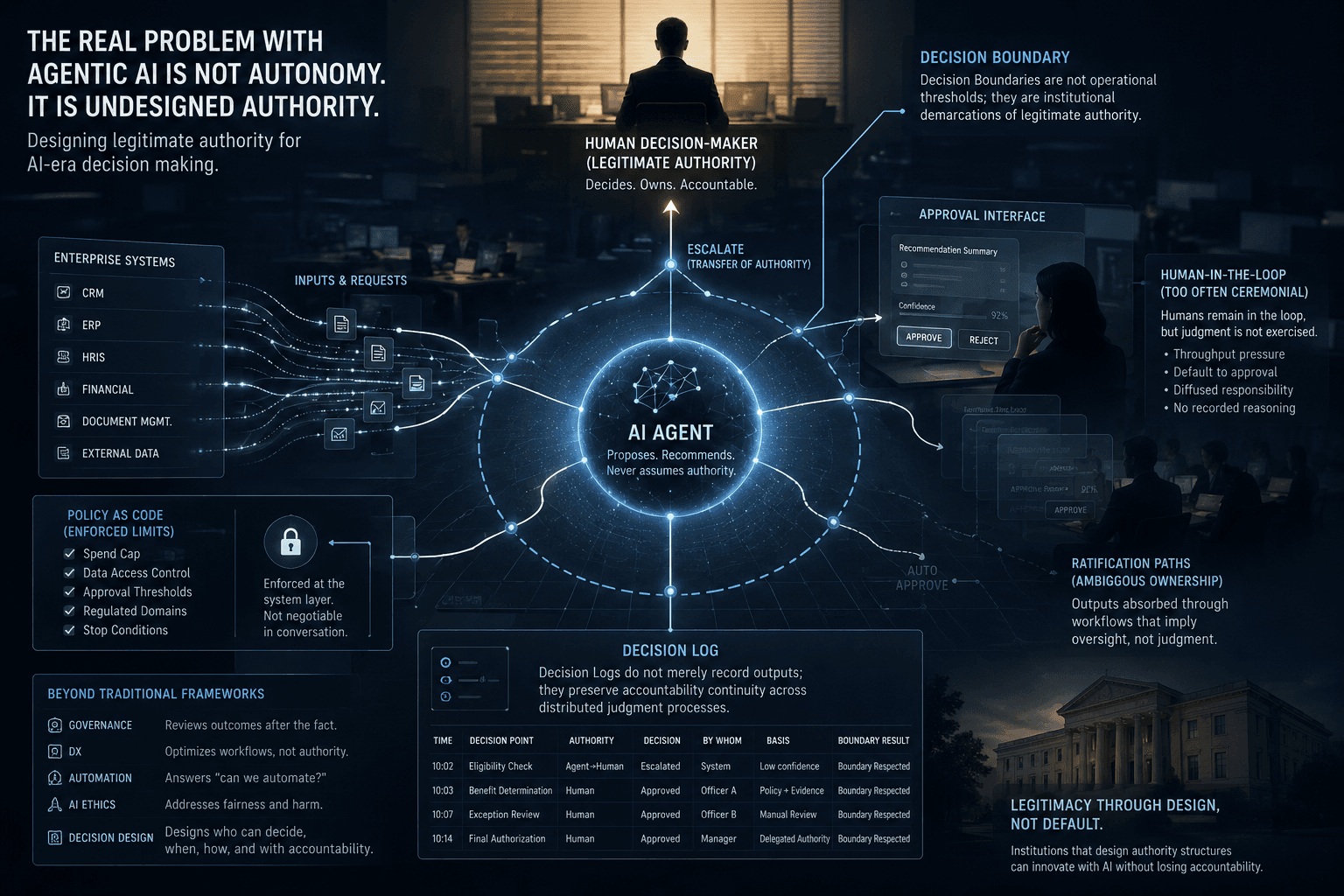
As governments move to require human judgment in AI agent deployments, the real governance challenge is not human presence alone, but the design of legitimate authority. This article introduces Decision Design, Decision Boundaries, and Decision Logs as the institutional architecture needed to govern autonomous AI systems with accountability continuity.

2026-03-13

When AI Moves Closer to Judgment: The Boundary Problem Banks Are Not Designing For

When AI Moves Closer to Judgment: The Boundary Problem Banks Are Not Designing For

Chiba Bank's plan to deploy AI across work equivalent to 2,000 employees raises a question that goes beyond productivity: what kind of work is AI being moved into? When AI is positioned near evaluation, screening, audit, or risk assessment, the real issue is not capability—it is whether institutions have designed where human judgment must remain, and who bears responsibility when outputs are wrong.

2026-03-12

What Salesforce Didn't Say: The Interface Has Changed, and So Has the Problem

What Salesforce Didn't Say: The Interface Has Changed, and So Has the Problem

A measured defense of SaaS misses the deeper shift underway: in the AI agent era, the interface is no longer just a display layer. It is becoming the operational surface where delegation, confirmation, interruption, and accountability are structured. The real issue is not whether SaaS survives, but how enterprise systems design judgment through Decision Boundary (organizational governance), Human Judgment Decision Boundary, and Governance Decision Boundary.

2026-03-11

When AI "Judges" and RPA Executes: Who Actually Draws the Line?

When AI "Judges" and RPA Executes: Who Actually Draws the Line?

As generative AI begins to function as judgment and RPA turns that output into action, the real issue is no longer automation alone but where organizations draw the Decision Boundary between AI output, human judgment, and formal governance accountability.

2026-03-10

Beyond Risk and Literacy: Why AI Governance Needs Judgment Architecture

Beyond Risk and Literacy: Why AI Governance Needs Judgment Architecture

AI governance does not become a competitive advantage through risk analysis or workforce literacy alone. The missing layer is judgment architecture: designing where AI delegation ends, where accountable human judgment begins, and where governance must formally intervene.

2026-03-09

AI Agent Liability Is the Wrong Debate — The Real Problem Is Decision Architecture

AI Agent Liability Is the Wrong Debate — The Real Problem Is Decision Architecture

As AI agents begin making operational decisions in finance, hiring, healthcare, and infrastructure, the global governance debate has focused on liability — who is responsible when AI causes harm. But liability frameworks operate after the fact. They assign consequences once damage has already occurred. The deeper issue lies earlier: how decisions are structured before AI systems are deployed. This article introduces the concept of Decision Design — the deliberate architecture of organizational decision-making in human-AI systems. It explains how three boundaries shape accountable AI governance: the Decision Boundary (organizational governance), the Human Judgment Decision Boundary, and the Governance Decision Boundary. Without explicitly designing these boundaries, organizations risk creating systems where AI influence expands silently while human accountability becomes purely formal.

2026-03-09

The Better the Output Looks, the Less We Question It

The Better the Output Looks, the Less We Question It

Polished AI outputs do not simply improve productivity. They also reduce human scrutiny. Drawing on Anthropic’s AI Fluency Index, this article argues that AI discernment should not be treated as a talent problem, but as a judgment architecture and governance design problem.

2026-03-08

When AI Output Becomes Advice: The Nippon Life vs. OpenAI Case and the Governance Gap It Exposes

When AI Output Becomes Advice: The Nippon Life vs. OpenAI Case and the Governance Gap It Exposes

The Nippon Life vs. OpenAI lawsuit highlights a structural governance gap: when AI output functions as advice but no accountable advisor exists. This article examines why the issue is not model accuracy, but the absence of designed judgment boundaries, authority structures, and accountability connections in AI deployment.

2026-03-06

AI Does Not Reduce Work. It Intensifies It—Because Nobody Has Designed the Handoff.

AI Does Not Reduce Work. It Intensifies It—Because Nobody Has Designed the Handoff.

AI often speeds up first-pass generation without reducing total work. Review, correction, approval, and accountability still remain human. The real issue is not AI usage alone, but the absence of a clear decision boundary defining where AI stops and human judgment begins.

2026-03-06

Can Japan's Government Turn AI Into Delivery Power?

Can Japan's Government Turn AI Into Delivery Power?

When governments deploy AI, the question is not merely adoption—it is accountability. As Japan’s Digital Agency and Tokyo Metropolitan Government scale their Government AI platform “Gennai,” a deeper design challenge emerges: who decides, and where does responsibility reside? From formal screening to substantive review to final human decision, public-sector AI reveals a structural tension between speed and judgment. This article explores how “delivery power” reshapes governance—and why the true frontier of AI implementation lies in designing the Decision Boundary (organizational governance). Beyond experimentation, 2026 marks the shift from AI pilots to measurable outcomes. The real question is no longer whether AI works, but how Human Judgment Decision Boundary and Governance Decision Boundary must be architected to sustain trust.

2026-03-03

Trust in Physical AI Cannot Be Declared. It Must Be Architected.

Trust in Physical AI Cannot Be Declared. It Must Be Architected.

Physical AI is forcing executives to rethink what trust means in operational systems. As AI moves into vehicles, factories, warehouses, and infrastructure, performance is no longer enough. What matters is whether decision authority, accountability, and governance structures are explicitly designed. This article argues that AI risk does not primarily emerge inside models, but at organizational and operational interfaces where responsibility is unclear. It introduces the concept of the Decision Boundary (organizational governance) as the structural definition of where AI autonomy ends and accountable human authority begins. By distinguishing Human Judgment Decision Boundary and Governance Decision Boundary, the piece reframes AI trust as an architectural problem of decision structure design rather than compliance or ethics alone. In physical AI, trust cannot be declared. It must be engineered through deliberate boundary design, accountability allocation, and lifecycle governance.

2026-03-02

Human Oversight Is Not Enough — The Real Problem Is the Decision Boundary

Human Oversight Is Not Enough — The Real Problem Is the Decision Boundary

Building on Alex “Sandy” Pentland’s argument that AI requires human oversight due to its reliance on backward-looking data, this article argues that oversight alone is not governance. The real issue is the absence of a clearly defined Decision Boundary (organizational governance). Introducing the Human Judgment Decision Boundary and the Governance Decision Boundary, it presents a practical three-layer architecture — Proposal, Approval, Accountability — with re-evaluation triggers and escalation logic under uncertainty. This framework shifts AI governance from symbolic human involvement to structured decision authority design.

2026-03-01

After Risk Mapping, What Gets Designed? Decision Boundary (Organizational Governance) as the Next Layer for Agentic AI

After Risk Mapping, What Gets Designed? Decision Boundary (Organizational Governance) as the Next Layer for Agentic AI

UC Berkeley’s “Agentic AI Risk-Management Standards Profile” marks a pivotal shift in AI governance — from model-level evaluation to system-level risk mapping. It identifies cascading failures, accountability diffusion, and goal drift as structural risks unique to autonomous AI agents. Yet risk mapping alone does not determine how organizations allocate judgment authority between humans and AI. This article introduces Decision Boundary (organizational governance) as the next governance layer. While risk frameworks manage consequences, Decision Boundary designs authority — specifying who decides what, under which conditions, and through what accountability structure. By distinguishing Human-in-the-loop from Human Judgment Decision Boundary and Governance Decision Boundary, this essay reframes AI governance as an architectural problem rather than a compliance exercise. The future of agentic AI governance depends not only on managing risks, but on deliberately designing the boundaries of organizational judgment.

2026-02-28

Who Actually Decides?

Who Actually Decides?

AI adoption is accelerating across organizations, but few are asking a more fundamental question: who actually decides? As AI drafts strategy, evaluates risk, and generates recommendations, decision authority can quietly shift. The issue is not human cognitive decline, but positional displacement — a movement of the “seat of judgment” from human actors to AI-generated reasoning. Regulators increasingly mandate human oversight, yet they cannot specify where the boundary between AI contribution and human judgment should lie. That design responsibility falls to organizations themselves. This article introduces Decision Design and the concept of a Decision Boundary — a structured approach to defining where AI ends and human accountability begins. In the AI era, clarity about that line is not a philosophical concern. It is an architectural one.

2026-02-27

Can AI Truly Prevent Financial Crime?

Can AI Truly Prevent Financial Crime?

As banks accelerate AI adoption in KYC, AML, and transaction monitoring, a deeper structural question emerges: can AI truly prevent financial crime? While AI significantly enhances detection capabilities, it cannot assume judgment. This article explores the distinction between detection and decision-making, the structural limits of AI in handling first-time offenders and synthetic identities, and why financial institutions must deliberately design the boundary between automated systems and human responsibility. Introducing the concept of Decision Design and Decision Boundary, the piece argues that the future of AI governance is not about better models—but about consciously architecting who decides, under what conditions, and where accountability resides.

2026-02-27

AI Agents Don't Eliminate Decisions. They Expose the Absence of Decision Design.

AI Agents Don't Eliminate Decisions. They Expose the Absence of Decision Design.

AI agents are often celebrated for accelerating workflows and reducing costs. But speed is not the structural issue. As organizations deploy increasingly autonomous systems, a deeper problem emerges: decision authority, responsibility, and auditability were rarely designed in the first place. Drawing on recent enterprise cases in manufacturing and procurement, this article argues that the real challenge of agentic AI is not automation, but the architectural void where accountability should exist. Process modeling tools can allocate tasks. They do not define who owns a decision. As regulators worldwide emphasize human oversight requirements, organizations must move beyond workflow optimization and deliberately design decision structures. The article introduces Decision Design and Decision Boundary Mapping as practical frameworks for clarifying authority, assigning responsibility, and ensuring auditability at the human–AI boundary. AI agents do not eliminate decisions. They expose the absence of decision architecture.

2026-02-26

If the Work Takes 10 Minutes, Why Do You Still Need a Human?

If the Work Takes 10 Minutes, Why Do You Still Need a Human?

Novo Nordisk reduced the production time of clinical study reports from over ten weeks to ten minutes using AI. Yet the compression of drafting did not eliminate human responsibility. The AI writes. Humans review, evaluate, and sign. As agentic systems like Claude Cowork extend AI execution across enterprise knowledge work, the central question shifts from capability to accountability: when AI executes, who owns the judgment? This article examines the structural distinction between task automation and judgment relocation. Drawing from pharmaceutical regulation, the EU AI Act, and emerging global oversight requirements, it argues that organizations must deliberately design the boundary between AI execution and human authority. The concept of Decision Design introduces judgment itself as an object of organizational design. Its core structural element — the Decision Boundary — defines where delegation ends and responsibility begins. Speed increased. Judgment did not disappear.

2026-02-26

When Agents Act, Who Decided?

When Agents Act, Who Decided?

AI agents can automate workflows—but they also dissolve the accountability infrastructure SaaS quietly provided: identity, audit trails, and decision attribution. As “shadow agents” spread and agent counts reach workforce scale, “human-in-the-loop” stops scaling. This essay introduces Decision Design and the Decision Boundary as a practical way to make judgment ownership explicit, visible, and maintainable—before governance becomes performative.

2026-02-26

The Real Problem With Military AI Isn't Ethics. It's Boundary Design.

The Real Problem With Military AI Isn't Ethics. It's Boundary Design.

The conflict between the U.S. Department of Defense and Anthropic is often framed as an ethics debate. It is not. This article argues that the real issue is the absence of a shared architecture for allocating judgment authority between states, AI providers, and autonomous systems. Introducing the concept of Decision Design, it proposes practical frameworks — including a Tri-Layer Decision Model and a Decision Ledger — for structuring responsibility in military AI deployment.

2026-02-25

Is Back-Office Automation Really About Automation?

Is Back-Office Automation Really About Automation?

AI approving expense reports appears to be a story of efficiency. But beneath the surface, something more structural is happening. When organizations convert internal policies into machine-readable formats and delegate approval authority to AI, they are not merely automating tasks — they are transferring judgment. This article argues that existing frameworks — Governance, Digital Transformation, Automation, and AI Ethics — are necessary but insufficient to address the architectural implications of AI-driven decision delegation. Introducing Decision Design and Decision Boundary as the missing design layer, the piece outlines the structural risks of judgment compression, responsibility dilution, capability erosion, and boundary drift — and proposes a three-layer implementation model for sustainable AI-native enterprises.

2026-02-24

Why AI Agents Fail in Practice — And Why Architecture Alone Won't Fix It

Why AI Agents Fail in Practice — And Why Architecture Alone Won't Fix It

AI agent failures in enterprise workflows are often described as architecture problems. Missing constraints, weak validation layers, limited observability, and poorly designed escalation paths are frequently cited as root causes. But beneath these architectural gaps lies a deeper structural issue: the absence of designed judgment. This article argues that AI agent breakdowns are not primarily model failures nor purely infrastructure deficiencies. They are symptoms of an undefined decision structure — where authority, delegation, and accountability boundaries between AI and humans remain implicit. Introducing the concepts of Decision Design and Decision Boundary, this analysis reframes AI agent failure as an organizational design challenge. It also outlines a practical framework for specifying non-decision conditions, escalation thresholds, decision ledgers, and responsibility transfer protocols. Architecture matters. But without deliberate judgment design, architecture alone will not prevent failure.

2026-02-24

When Intelligence Becomes Abundant, Judgment Must Be Designed

When Intelligence Becomes Abundant, Judgment Must Be Designed

As AI systems compress cognition and accelerate output generation, the bottleneck in modern institutions shifts from information access to judgment allocation. In response to Craig Mundie’s call for educational reform in the AI era, this essay reframes the debate: the central issue is not curriculum redesign, but structural responsibility design. Introducing Decision Design, a framework for intentionally allocating judgment authority in AI-augmented environments, this article argues that institutions must explicitly define where AI authority ends and human authority begins. Through the concept of Decision Boundary, it proposes operational methods for preventing unconscious delegation and accountability drift. Education becomes the earliest test case—but the implications extend far beyond it. When intelligence becomes abundant, judgment must be designed.

2026-02-24

When Intelligence Becomes Abundant, What Becomes Scarce?

When Intelligence Becomes Abundant, What Becomes Scarce?

As AI systems accelerate and claims of superintelligence grow louder, a deeper question emerges: what exactly does it mean for AI to “outperform” a CEO? This article separates computation from judgment and argues that executive decision-making is not merely an optimization problem. While AI can process information, simulate outcomes, and recommend actions at unprecedented scale, governance requires something fundamentally different: accountable commitment. The real risk is not that AI becomes smarter than executives, but that organizations allow decision-making to hollow out—where AI outputs are executed without a clearly designated human agent assuming responsibility. To address this structural risk, the article introduces Decision Design and the concept of the Decision Boundary: the intentional architectural demarcation between AI contribution and human accountability. As intelligence becomes abundant, judgment—and its governance—may become the scarce resource organizations must deliberately protect.

2026-02-23

What "50% of Tasks Can Be Automated" Fails to Measure

What "50% of Tasks Can Be Automated" Fails to Measure

Anthropic’s Economic Index suggests that nearly 50% of tasks performed with Claude are automation-oriented and that AI could raise U.S. labor productivity by 1.8 percentage points annually. These figures are compelling—but they describe AI capability, not organizational structure. This essay argues that automation metrics fail to capture second-order effects: Decision Compression (the quiet migration of judgment into AI systems), the breakdown of training pathways for junior professionals, and the erosion of accountability when human approval becomes procedural rather than substantive. The real question is not how much AI can automate, but where the boundary between human and AI judgment should be drawn—and who designs it. Introducing Decision Design: a framework for intentionally structuring judgment, responsibility, and learning in AI-native organizations.

2026-02-22

AI Literacy Is Now a Job Requirement in VC. But the Real Question Is Being Missed.

AI Literacy Is Now a Job Requirement in VC. But the Real Question Is Being Missed.

Venture capital firms are making AI literacy a formal hiring requirement. But the real issue is not whether professionals can use AI tools — it is whether organizations have designed how AI-informed decisions are made. Bloomberg reports that VCs evaluate candidates on their ability to select tools, prompt effectively, and integrate AI outputs into judgment. Yet the most critical layer — integration — lacks any formal structure. If AI shapes the informational foundation of decisions, then maintaining human agency requires more than a “human-in-the-loop” claim. It requires an explicit design of the decision boundary. This essay introduces Decision Design — a methodology for structuring how judgment is made in AI-mediated environments — and proposes practical mechanisms such as the Judgment Ledger to restore accountability, verifiability, and durable human agency.

2026-02-22

The Undesigned Decision: Why AI Agents Expose a Governance Void, Not a Security Flaw

The Undesigned Decision: Why AI Agents Expose a Governance Void, Not a Security Flaw

The 2025 AI Agent Index published through MIT CSAIL reveals a structural governance gap in deployed AI agents. Across 30 prominent systems, researchers found widespread deficiencies in safety disclosure, execution traceability, identity transparency, and third-party evaluation. Yet the deeper issue is not cybersecurity. Security assumes defined boundaries. The more fundamental problem is that most enterprise AI agents operate without explicitly designed decision scope, authorization limits, or structured accountability. This essay argues that the real governance failure is architectural: organizations are deploying judgment-bearing systems without designing the boundaries of what those systems are authorized to decide. Introducing Decision Design and the concept of the Decision Boundary, the article outlines how enterprises can move from reactive security posture to structured judgment governance, including a practical implementation model—the Agent Decision Ledger.

2026-02-21

AI Isn't Eliminating Jobs. It's Revealing Who Forgot to Design the Decisions.

AI Isn't Eliminating Jobs. It's Revealing Who Forgot to Design the Decisions.

AI is widely portrayed as the direct cause of an impending wave of white-collar layoffs. But the causal chain is far less straightforward than headlines suggest. Productivity gains remain uneven and difficult to measure, while recent workforce reductions correlate more strongly with post-pandemic overcorrection and capital market pressure than with AI-driven surplus. The deeper issue is not technological capability, but decision architecture. When companies attribute restructuring to “AI efficiency,” responsibility can become obscured. This article examines how organizations can redesign their decision structures—through Decision Design and explicit Decision Boundaries—to ensure accountability remains human, even in AI-augmented environments.

2026-02-21

Headcount Is Not the Problem: Decision Architecture in the Age of AI Workforce Reduction

Headcount Is Not the Problem: Decision Architecture in the Age of AI Workforce Reduction

AI-driven workforce reductions are often framed as a headcount issue. But the deeper structural risk lies elsewhere. When routine work is automated and employees are removed, organizations frequently fail to redesign the architecture of judgment that those roles once embodied. This essay reframes AI-related workforce change as a governance challenge rather than a labor statistic. Through cases involving Mizuho Financial Group, Accenture, and Commonwealth Bank of Australia, it argues that the true risk is not job displacement but the erosion of accountable decision-making. Introducing Decision Design and the concept of Decision Boundaries, the article outlines a practical governance architecture for AI-augmented organizations — including irreversible decision registers, human authorization layers, decision ledgers, and boundary mapping frameworks. Headcount is visible. Decision architecture is not. The difference determines whether AI transformation strengthens an organization — or hollow it out.

2026-02-21

The Handshake That Didn't Happen: What the India AI Summit Revealed

The Handshake That Didn't Happen: What the India AI Summit Revealed

When OpenAI and Anthropic CEOs declined to hold hands at the India AI Summit, the moment was widely framed as rivalry. But the signal runs deeper. As AI firms increasingly operate at governance scale, the issue is not competition itself, but the absence of competitive architecture. This article examines the structural divergence between scaling-first and boundary-first governance models—and argues that what AI lacks is a designed boundary of judgment.

2026-02-20

The Ownership Problem

The Ownership Problem

AI can simulate reasoning. It cannot simulate consequence. As responsibility diffuses through optimized systems, institutions risk displacing ownership while satisfying governance. This article argues that ownership under uncertainty is the defining ethical challenge of the AI-native enterprise.

2026-02-18

The Courage Layer

The Courage Layer

Optimization reduces risk. It does not eliminate uncertainty. Beyond intelligence, governance, and ownership lies a final institutional layer: courage. This article explores how AI-native enterprises must design structures that make principled divergence possible.

2026-02-18

The Performance Layer

The Performance Layer

In AI-native enterprises, judgment can be performed fluently without being formed through consequence. This article explores synthetic confidence, the rise of performative authority, and the structural risks of endorsement masquerading as commitment.

2026-02-18

The Formation Gap: Why Decision Design Must Become Architecture for Judgment, Not Just Governance

The Formation Gap: Why Decision Design Must Become Architecture for Judgment, Not Just Governance

AI does not eliminate work. It eliminates the terrain on which judgment was historically formed. As apprenticeship layers compress, organizations risk producing professionals fluent in tools but unformed in authority. This article examines the structural formation gap emerging inside AI-augmented enterprises.

2026-02-18

When Intelligence Becomes Abundant, Judgment Becomes Scarce

When Intelligence Becomes Abundant, Judgment Becomes Scarce

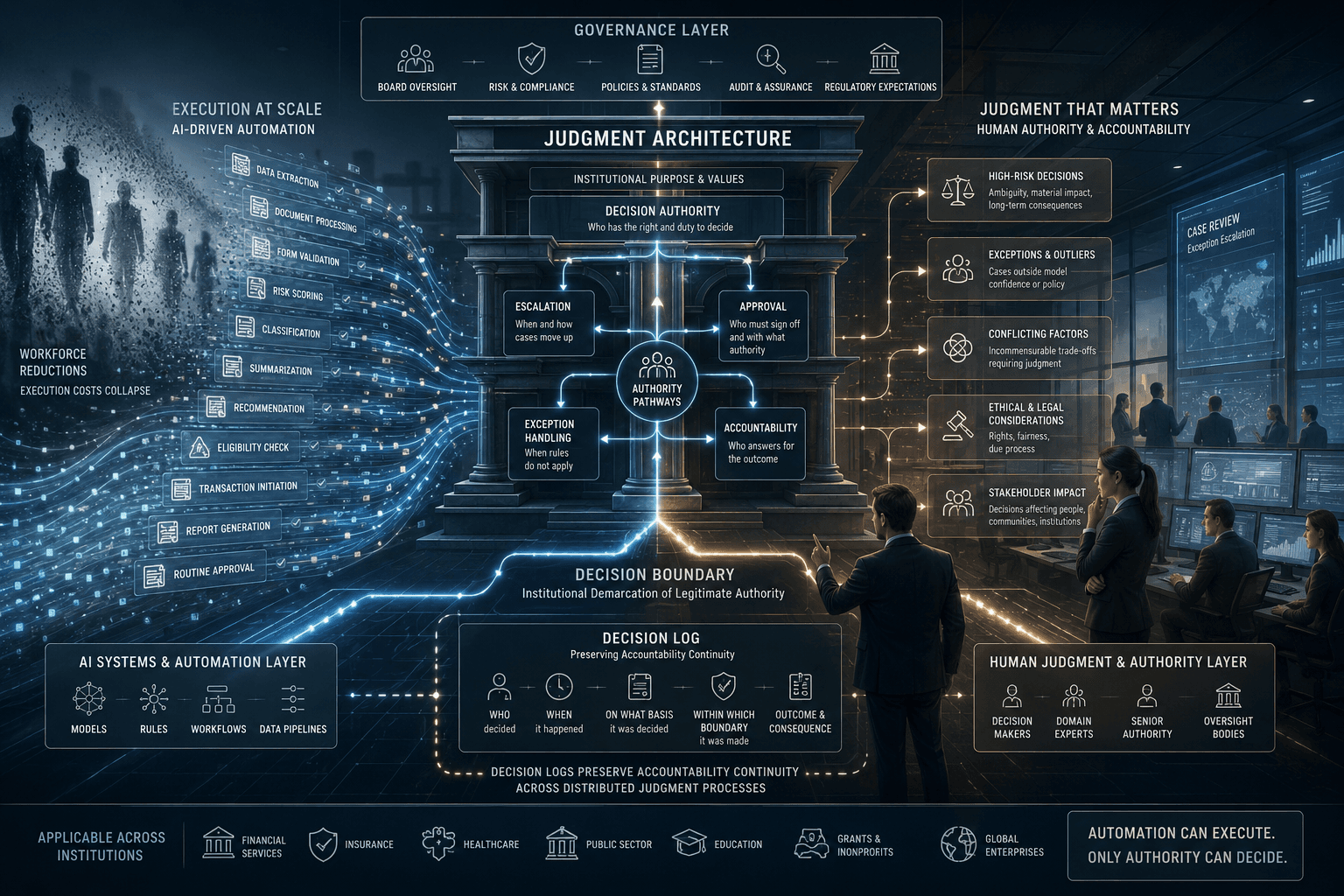
When AI systems can pass professional and national examinations, intelligence ceases to be a scarce asset. The new bottleneck is not analysis, but authority — who decides, who bears consequence, and where delegation ends. This article argues that Decision Design is the missing architectural layer in the AI-native enterprise.

2026-02-18

The Architecture of Judgment: What a Japanese Deployment Reveals About the Missing Layer in Enterprise AI Agents

The Architecture of Judgment: What a Japanese Deployment Reveals About the Missing Layer in Enterprise AI Agents

As enterprise AI agents become increasingly autonomous, capability is no longer the limiting factor — accountability is. Using JTB’s weather-disruption AI agent as a case study, this article introduces Decision Design and Decision Boundary as the missing architectural layer in enterprise autonomy. It argues that judgment must be decomposed, allocated, and gated before autonomy is scaled, and presents a portable method for designing irreversible action gates and accountability structures in real-world operations.

2026-02-16

The Government Wrote "Judgment" Into Policy. Its Content Is Blank.

The Government Wrote "Judgment" Into Policy. Its Content Is Blank.

Japan is beginning to write “judgment” into the formal vocabulary of AI governance. A reported update to the MIC/METI AI Business Operator Guidelines introduces the requirement for “a mechanism that makes human judgment mandatory” for AI agents and physical AI systems. But policy recognition is not design. What remains undefined is what valid judgment structurally contains: its unit, evidence requirements, responsibility boundaries, and reproducibility conditions. This article argues that the resulting gap—between policy intent (“judgment is required”) and operational reality (“judgment becomes a checkbox”)—is not an ethics problem but an architectural one. It introduces Decision Design as the missing layer: a discipline for designing the structure of judgment, and Decision Boundary as its core concept. The piece concludes with implementable artifacts—Decision Log and Decision Boundary Map—to convert “reviewed” from ritual into traceable, reproducible organizational judgment.

2026-02-15

When the Web Stops Reading Us Back

When the Web Stops Reading Us Back

When the web’s primary reader shifts from humans to agents, the consequences extend far beyond formatting. As infrastructure providers enable machine-native content delivery — such as automatic markdown responses to agent requests — a deeper structural transition becomes visible. Increasingly, web content is parsed, summarized, and acted upon by autonomous systems before any human sees it. This shift alters not only interface design, but the foundations of authority, trust formation, and decision velocity inside organizations. While technical infrastructure for an agent-native web is rapidly maturing, most enterprises have not redesigned their internal decision architectures to account for agent-mediated workflows. The result is a growing gap between automation capability and governance readiness. When the subject of the web changes, the architecture of responsibility must change with it.

2026-02-14

The Structural Limit of Human-in-the-Loop

The Structural Limit of Human-in-the-Loop

Human-in-the-Loop (HITL) is widely treated as a safety mechanism in AI governance. But can it remain structurally sustainable in an agentic environment? This article examines the limits of HITL and proposes boundary design as the next architectural layer. A structural examination of Human-in-the-Loop governance in the age of AI agents. Using a Japanese administrative guideline (DS-920) as a case reference, this article argues that safety can no longer rely on human intervention alone — and must shift toward architectural decision boundary design.

2026-02-13

Fair Use Was Designed for Humans. AI Doesn’t Forget.

Fair Use Was Designed for Humans. AI Doesn’t Forget.

The Anthropic settlement is widely understood as a landmark copyright case. But its deeper significance lies elsewhere. By affirming that lawfully sourced training data may qualify as transformative fair use, the ruling clarifies legal boundaries for AI development. At the same time, it exposes a structural tension: fair use doctrine was designed for human cognition — finite, sequential, and forgetful. AI systems operate differently. Machine-scale memory is persistent, non-decaying, and globally deployable. This asymmetry between human knowledge and permanent machine retention introduces a governance challenge that copyright law alone cannot resolve. This article reframes the settlement as a test of institutional design rather than intellectual property. It examines the divergence between institutional memory and institutional authority, and argues that the central issue is not data ingestion but boundary architecture. The question for leaders is no longer whether training data is lawful — but whether Decision Boundaries are intentionally designed in the age of permanent machine memory.

2026-02-12

The Architecture of Remaining Judgment

The Architecture of Remaining Judgment

As organizations accelerate AI adoption, many fear competitive flattening — the idea that shared models will erase strategic differentiation. But the deeper risk is not technological convergence. It is the quiet dissolution of Decision Boundaries. AI functions as a compression engine. It reduces the distance between question and output, accelerating the arrival of decision moments. Yet compression does not constitute judgment. When organizations fail to deliberately design where analysis ends and institutional responsibility begins, they risk organizational hollowing — a condition in which formal authority remains, but substantive cognition has migrated elsewhere. This Insight explores how Judgment Retention, Decision Boundaries, and the practice of maintaining a Decision Ledger form a structural architecture for preserving competitive advantage in the age of shared models. Advantage does not live in proprietary tools alone. It lives in the designed tension between compression and retained judgment.

2026-02-10

The Word That Suspends Judgment

The Word That Suspends Judgment

Artificial General Intelligence is invoked as the most consequential technological goal of our time—yet no one can clearly define what it is or when it arrives. This Insight examines how the undefined nature of “AGI” has become structurally useful: not as a technical roadmap, but as a way to defer judgment, accountability, and governance in organizations making AI-driven decisions today. The real challenge is not anticipating AGI, but deliberately designing where judgment lives before it ever arrives.

2026-02-10

When Software Stops Being the Place Where Work Happens

When Software Stops Being the Place Where Work Happens

In early 2026, markets reacted sharply to the rise of AI agents, framing the moment as the “death of SaaS.” But what is actually being repriced is not software itself, but a deeper assumption: that work, judgment, and execution naturally live inside applications. As AI agents relocate execution outside traditional interfaces, legacy SaaS economics begin to unravel — not because the software fails, but because the judgment boundaries embedded in it quietly dissolve. This Insight examines why the real disruption is not technological, but architectural: the unbuilt layer of decision boundaries in organizations where execution has become autonomous.

2026-02-09

Chutzpah Is Not a Trait. It Is a Structure.

Chutzpah Is Not a Trait. It Is a Structure.

Organizations say they need bold, independent decision-makers. Yet the systems they built over decades quietly removed the conditions under which judgment was ever practiced. This essay argues that “chutzpah” is not a personality trait, but a structural necessity—revealing why AI has not eliminated judgment, but erased the environments where judgment was formed. Through the lens of Decision Design and Decision Boundary, it reframes the talent debate as an architectural problem, not a human one.

2026-02-08

The Big 4’s AI Talent Problem Isn’t About AI — It’s About a Design That Was Never There

The Big 4’s AI Talent Problem Isn’t About AI — It’s About a Design That Was Never There

Agentic AI didn’t break talent development in professional services. It exposed something more fundamental: judgment was never deliberately designed. This Insight examines how AI hollowed out decision boundaries—and why organizations must now design where judgment lives.

2026-02-07

The Layoffs Are Real. The Explanation Is Wrong.

The Layoffs Are Real. The Explanation Is Wrong.

Mass layoffs are real. But the idea that AI is directly replacing human workers obscures a deeper organizational failure. This Insight argues that what is actually collapsing inside many organizations is decision ownership: the clear assignment of who is responsible for judgment, authority, and consequences. AI has not displaced these roles. It has revealed how poorly they were designed in the first place.

2026-02-06

AI Did Not Remove Judgment. We Removed the Conditions That Formed It.

AI Did Not Remove Judgment. We Removed the Conditions That Formed It.

Generative AI has not eliminated human judgment. It has removed the conditions under which judgment was historically formed. Responding to David Duncan’s Harvard Business Review essay, this Insight examines how AI accelerates work up to a boundary—but does not carry responsibility, ownership, or evaluative capacity across it. The real challenge organizations now face is not training people to review AI output, but deliberately designing where judgment is learned, exercised, and sustained.

2026-02-05

AI Does Not Replace Thinking. It Reveals Whether You Designed It.

AI Does Not Replace Thinking. It Reveals Whether You Designed It.

A response essay to Forbes' “Why AI Won’t Replace Your Thinking—Unless You Let It,” reframing AI not as a replacement for human intelligence, but as a force that reveals whether judgment and responsibility have been deliberately designed.

2026-02-05

The Quiet Disappearance of Judgment: Voice, AI, and the Architecture of Human Deciding

The Quiet Disappearance of Judgment: Voice, AI, and the Architecture of Human Deciding

As voice-first AI interfaces dissolve friction between intention and execution, the space in which human judgment once formed is quietly collapsing. This essay explores how seamless AI interaction erodes Decision Boundaries, why “human-in-the-loop” is no longer sufficient, and why judgment must now be deliberately designed rather than assumed.

2026-02-05

The Last Signature

The Last Signature

AI accelerates drafting reports and papers, but human review and approval cannot scale at the same pace. The real bottleneck is judgment—and most organizations have not designed for it. Generative AI has made production faster. But the human judgment required at the end of every workflow—the signature that accepts accountability—has not scaled. The result is a structural bottleneck that better models and stricter guidelines cannot solve.

2026-02-01

Why "High Agency" Is Becoming the Defining Human Capability in the Age of AI

Why "High Agency" Is Becoming the Defining Human Capability in the Age of AI

As AI makes execution cheap, judgment becomes scarce. This essay argues that “High Agency” is not a mindset but a design problem—one that. organizations must solve deliberately. Introducing the concept of hollow judgment, it examines how AI systems can preserve the appearance of human oversight while quietly eroding real responsibility. High Agency, the article contends, must be designed across individuals, organizations, and AI systems through clear decision boundaries and accountability.

2026-01-31
All

What Salesforce Didn't Say: The Interface Has Changed, and So Has the Problem

A measured defense of SaaS misses the deeper shift underway: in the AI agent era, the interface is no longer just a display layer. It is becoming the operational surface where delegation, confirmation, interruption, and accountability are structured. The real issue is not whether SaaS survives, but how enterprise systems design judgment through Decision Boundary (organizational governance), Human Judgment Decision Boundary, and Governance Decision Boundary.

AI Agent Liability Is the Wrong Debate — The Real Problem Is Decision Architecture

As AI agents begin making operational decisions in finance, hiring, healthcare, and infrastructure, the global governance debate has focused on liability — who is responsible when AI causes harm. But liability frameworks operate after the fact. They assign consequences once damage has already occurred. The deeper issue lies earlier: how decisions are structured before AI systems are deployed. This article introduces the concept of Decision Design — the deliberate architecture of organizational decision-making in human-AI systems. It explains how three boundaries shape accountable AI governance: the Decision Boundary (organizational governance), the Human Judgment Decision Boundary, and the Governance Decision Boundary. Without explicitly designing these boundaries, organizations risk creating systems where AI influence expands silently while human accountability becomes purely formal.

Can Japan's Government Turn AI Into Delivery Power?

When governments deploy AI, the question is not merely adoption—it is accountability. As Japan’s Digital Agency and Tokyo Metropolitan Government scale their Government AI platform “Gennai,” a deeper design challenge emerges: who decides, and where does responsibility reside? From formal screening to substantive review to final human decision, public-sector AI reveals a structural tension between speed and judgment. This article explores how “delivery power” reshapes governance—and why the true frontier of AI implementation lies in designing the Decision Boundary (organizational governance). Beyond experimentation, 2026 marks the shift from AI pilots to measurable outcomes. The real question is no longer whether AI works, but how Human Judgment Decision Boundary and Governance Decision Boundary must be architected to sustain trust.

Trust in Physical AI Cannot Be Declared. It Must Be Architected.

Physical AI is forcing executives to rethink what trust means in operational systems. As AI moves into vehicles, factories, warehouses, and infrastructure, performance is no longer enough. What matters is whether decision authority, accountability, and governance structures are explicitly designed. This article argues that AI risk does not primarily emerge inside models, but at organizational and operational interfaces where responsibility is unclear. It introduces the concept of the Decision Boundary (organizational governance) as the structural definition of where AI autonomy ends and accountable human authority begins. By distinguishing Human Judgment Decision Boundary and Governance Decision Boundary, the piece reframes AI trust as an architectural problem of decision structure design rather than compliance or ethics alone. In physical AI, trust cannot be declared. It must be engineered through deliberate boundary design, accountability allocation, and lifecycle governance.

Human Oversight Is Not Enough — The Real Problem Is the Decision Boundary

Building on Alex “Sandy” Pentland’s argument that AI requires human oversight due to its reliance on backward-looking data, this article argues that oversight alone is not governance. The real issue is the absence of a clearly defined Decision Boundary (organizational governance). Introducing the Human Judgment Decision Boundary and the Governance Decision Boundary, it presents a practical three-layer architecture — Proposal, Approval, Accountability — with re-evaluation triggers and escalation logic under uncertainty. This framework shifts AI governance from symbolic human involvement to structured decision authority design.

After Risk Mapping, What Gets Designed? Decision Boundary (Organizational Governance) as the Next Layer for Agentic AI

UC Berkeley’s “Agentic AI Risk-Management Standards Profile” marks a pivotal shift in AI governance — from model-level evaluation to system-level risk mapping. It identifies cascading failures, accountability diffusion, and goal drift as structural risks unique to autonomous AI agents. Yet risk mapping alone does not determine how organizations allocate judgment authority between humans and AI. This article introduces Decision Boundary (organizational governance) as the next governance layer. While risk frameworks manage consequences, Decision Boundary designs authority — specifying who decides what, under which conditions, and through what accountability structure. By distinguishing Human-in-the-loop from Human Judgment Decision Boundary and Governance Decision Boundary, this essay reframes AI governance as an architectural problem rather than a compliance exercise. The future of agentic AI governance depends not only on managing risks, but on deliberately designing the boundaries of organizational judgment.

Who Actually Decides?

AI adoption is accelerating across organizations, but few are asking a more fundamental question: who actually decides? As AI drafts strategy, evaluates risk, and generates recommendations, decision authority can quietly shift. The issue is not human cognitive decline, but positional displacement — a movement of the “seat of judgment” from human actors to AI-generated reasoning. Regulators increasingly mandate human oversight, yet they cannot specify where the boundary between AI contribution and human judgment should lie. That design responsibility falls to organizations themselves. This article introduces Decision Design and the concept of a Decision Boundary — a structured approach to defining where AI ends and human accountability begins. In the AI era, clarity about that line is not a philosophical concern. It is an architectural one.

Can AI Truly Prevent Financial Crime?

As banks accelerate AI adoption in KYC, AML, and transaction monitoring, a deeper structural question emerges: can AI truly prevent financial crime? While AI significantly enhances detection capabilities, it cannot assume judgment. This article explores the distinction between detection and decision-making, the structural limits of AI in handling first-time offenders and synthetic identities, and why financial institutions must deliberately design the boundary between automated systems and human responsibility. Introducing the concept of Decision Design and Decision Boundary, the piece argues that the future of AI governance is not about better models—but about consciously architecting who decides, under what conditions, and where accountability resides.

AI Agents Don't Eliminate Decisions. They Expose the Absence of Decision Design.

AI agents are often celebrated for accelerating workflows and reducing costs. But speed is not the structural issue. As organizations deploy increasingly autonomous systems, a deeper problem emerges: decision authority, responsibility, and auditability were rarely designed in the first place. Drawing on recent enterprise cases in manufacturing and procurement, this article argues that the real challenge of agentic AI is not automation, but the architectural void where accountability should exist. Process modeling tools can allocate tasks. They do not define who owns a decision. As regulators worldwide emphasize human oversight requirements, organizations must move beyond workflow optimization and deliberately design decision structures. The article introduces Decision Design and Decision Boundary Mapping as practical frameworks for clarifying authority, assigning responsibility, and ensuring auditability at the human–AI boundary. AI agents do not eliminate decisions. They expose the absence of decision architecture.

If the Work Takes 10 Minutes, Why Do You Still Need a Human?

Novo Nordisk reduced the production time of clinical study reports from over ten weeks to ten minutes using AI. Yet the compression of drafting did not eliminate human responsibility. The AI writes. Humans review, evaluate, and sign. As agentic systems like Claude Cowork extend AI execution across enterprise knowledge work, the central question shifts from capability to accountability: when AI executes, who owns the judgment? This article examines the structural distinction between task automation and judgment relocation. Drawing from pharmaceutical regulation, the EU AI Act, and emerging global oversight requirements, it argues that organizations must deliberately design the boundary between AI execution and human authority. The concept of Decision Design introduces judgment itself as an object of organizational design. Its core structural element — the Decision Boundary — defines where delegation ends and responsibility begins. Speed increased. Judgment did not disappear.

The Real Problem With Military AI Isn't Ethics. It's Boundary Design.

The conflict between the U.S. Department of Defense and Anthropic is often framed as an ethics debate. It is not. This article argues that the real issue is the absence of a shared architecture for allocating judgment authority between states, AI providers, and autonomous systems. Introducing the concept of Decision Design, it proposes practical frameworks — including a Tri-Layer Decision Model and a Decision Ledger — for structuring responsibility in military AI deployment.

Is Back-Office Automation Really About Automation?

AI approving expense reports appears to be a story of efficiency. But beneath the surface, something more structural is happening. When organizations convert internal policies into machine-readable formats and delegate approval authority to AI, they are not merely automating tasks — they are transferring judgment. This article argues that existing frameworks — Governance, Digital Transformation, Automation, and AI Ethics — are necessary but insufficient to address the architectural implications of AI-driven decision delegation. Introducing Decision Design and Decision Boundary as the missing design layer, the piece outlines the structural risks of judgment compression, responsibility dilution, capability erosion, and boundary drift — and proposes a three-layer implementation model for sustainable AI-native enterprises.

Why AI Agents Fail in Practice — And Why Architecture Alone Won't Fix It

AI agent failures in enterprise workflows are often described as architecture problems. Missing constraints, weak validation layers, limited observability, and poorly designed escalation paths are frequently cited as root causes. But beneath these architectural gaps lies a deeper structural issue: the absence of designed judgment. This article argues that AI agent breakdowns are not primarily model failures nor purely infrastructure deficiencies. They are symptoms of an undefined decision structure — where authority, delegation, and accountability boundaries between AI and humans remain implicit. Introducing the concepts of Decision Design and Decision Boundary, this analysis reframes AI agent failure as an organizational design challenge. It also outlines a practical framework for specifying non-decision conditions, escalation thresholds, decision ledgers, and responsibility transfer protocols. Architecture matters. But without deliberate judgment design, architecture alone will not prevent failure.

When Intelligence Becomes Abundant, Judgment Must Be Designed

As AI systems compress cognition and accelerate output generation, the bottleneck in modern institutions shifts from information access to judgment allocation. In response to Craig Mundie’s call for educational reform in the AI era, this essay reframes the debate: the central issue is not curriculum redesign, but structural responsibility design. Introducing Decision Design, a framework for intentionally allocating judgment authority in AI-augmented environments, this article argues that institutions must explicitly define where AI authority ends and human authority begins. Through the concept of Decision Boundary, it proposes operational methods for preventing unconscious delegation and accountability drift. Education becomes the earliest test case—but the implications extend far beyond it. When intelligence becomes abundant, judgment must be designed.

When Intelligence Becomes Abundant, What Becomes Scarce?

As AI systems accelerate and claims of superintelligence grow louder, a deeper question emerges: what exactly does it mean for AI to “outperform” a CEO? This article separates computation from judgment and argues that executive decision-making is not merely an optimization problem. While AI can process information, simulate outcomes, and recommend actions at unprecedented scale, governance requires something fundamentally different: accountable commitment. The real risk is not that AI becomes smarter than executives, but that organizations allow decision-making to hollow out—where AI outputs are executed without a clearly designated human agent assuming responsibility. To address this structural risk, the article introduces Decision Design and the concept of the Decision Boundary: the intentional architectural demarcation between AI contribution and human accountability. As intelligence becomes abundant, judgment—and its governance—may become the scarce resource organizations must deliberately protect.

What "50% of Tasks Can Be Automated" Fails to Measure

Anthropic’s Economic Index suggests that nearly 50% of tasks performed with Claude are automation-oriented and that AI could raise U.S. labor productivity by 1.8 percentage points annually. These figures are compelling—but they describe AI capability, not organizational structure. This essay argues that automation metrics fail to capture second-order effects: Decision Compression (the quiet migration of judgment into AI systems), the breakdown of training pathways for junior professionals, and the erosion of accountability when human approval becomes procedural rather than substantive. The real question is not how much AI can automate, but where the boundary between human and AI judgment should be drawn—and who designs it. Introducing Decision Design: a framework for intentionally structuring judgment, responsibility, and learning in AI-native organizations.

AI Literacy Is Now a Job Requirement in VC. But the Real Question Is Being Missed.

Venture capital firms are making AI literacy a formal hiring requirement. But the real issue is not whether professionals can use AI tools — it is whether organizations have designed how AI-informed decisions are made. Bloomberg reports that VCs evaluate candidates on their ability to select tools, prompt effectively, and integrate AI outputs into judgment. Yet the most critical layer — integration — lacks any formal structure. If AI shapes the informational foundation of decisions, then maintaining human agency requires more than a “human-in-the-loop” claim. It requires an explicit design of the decision boundary. This essay introduces Decision Design — a methodology for structuring how judgment is made in AI-mediated environments — and proposes practical mechanisms such as the Judgment Ledger to restore accountability, verifiability, and durable human agency.

The Undesigned Decision: Why AI Agents Expose a Governance Void, Not a Security Flaw

The 2025 AI Agent Index published through MIT CSAIL reveals a structural governance gap in deployed AI agents. Across 30 prominent systems, researchers found widespread deficiencies in safety disclosure, execution traceability, identity transparency, and third-party evaluation. Yet the deeper issue is not cybersecurity. Security assumes defined boundaries. The more fundamental problem is that most enterprise AI agents operate without explicitly designed decision scope, authorization limits, or structured accountability. This essay argues that the real governance failure is architectural: organizations are deploying judgment-bearing systems without designing the boundaries of what those systems are authorized to decide. Introducing Decision Design and the concept of the Decision Boundary, the article outlines how enterprises can move from reactive security posture to structured judgment governance, including a practical implementation model—the Agent Decision Ledger.

AI Isn't Eliminating Jobs. It's Revealing Who Forgot to Design the Decisions.

AI is widely portrayed as the direct cause of an impending wave of white-collar layoffs. But the causal chain is far less straightforward than headlines suggest. Productivity gains remain uneven and difficult to measure, while recent workforce reductions correlate more strongly with post-pandemic overcorrection and capital market pressure than with AI-driven surplus. The deeper issue is not technological capability, but decision architecture. When companies attribute restructuring to “AI efficiency,” responsibility can become obscured. This article examines how organizations can redesign their decision structures—through Decision Design and explicit Decision Boundaries—to ensure accountability remains human, even in AI-augmented environments.

Headcount Is Not the Problem: Decision Architecture in the Age of AI Workforce Reduction

AI-driven workforce reductions are often framed as a headcount issue. But the deeper structural risk lies elsewhere. When routine work is automated and employees are removed, organizations frequently fail to redesign the architecture of judgment that those roles once embodied. This essay reframes AI-related workforce change as a governance challenge rather than a labor statistic. Through cases involving Mizuho Financial Group, Accenture, and Commonwealth Bank of Australia, it argues that the true risk is not job displacement but the erosion of accountable decision-making. Introducing Decision Design and the concept of Decision Boundaries, the article outlines a practical governance architecture for AI-augmented organizations — including irreversible decision registers, human authorization layers, decision ledgers, and boundary mapping frameworks. Headcount is visible. Decision architecture is not. The difference determines whether AI transformation strengthens an organization — or hollow it out.

The Handshake That Didn't Happen: What the India AI Summit Revealed

When OpenAI and Anthropic CEOs declined to hold hands at the India AI Summit, the moment was widely framed as rivalry. But the signal runs deeper. As AI firms increasingly operate at governance scale, the issue is not competition itself, but the absence of competitive architecture. This article examines the structural divergence between scaling-first and boundary-first governance models—and argues that what AI lacks is a designed boundary of judgment.

The Architecture of Judgment: What a Japanese Deployment Reveals About the Missing Layer in Enterprise AI Agents

As enterprise AI agents become increasingly autonomous, capability is no longer the limiting factor — accountability is. Using JTB’s weather-disruption AI agent as a case study, this article introduces Decision Design and Decision Boundary as the missing architectural layer in enterprise autonomy. It argues that judgment must be decomposed, allocated, and gated before autonomy is scaled, and presents a portable method for designing irreversible action gates and accountability structures in real-world operations.

The Government Wrote "Judgment" Into Policy. Its Content Is Blank.

Japan is beginning to write “judgment” into the formal vocabulary of AI governance. A reported update to the MIC/METI AI Business Operator Guidelines introduces the requirement for “a mechanism that makes human judgment mandatory” for AI agents and physical AI systems. But policy recognition is not design. What remains undefined is what valid judgment structurally contains: its unit, evidence requirements, responsibility boundaries, and reproducibility conditions. This article argues that the resulting gap—between policy intent (“judgment is required”) and operational reality (“judgment becomes a checkbox”)—is not an ethics problem but an architectural one. It introduces Decision Design as the missing layer: a discipline for designing the structure of judgment, and Decision Boundary as its core concept. The piece concludes with implementable artifacts—Decision Log and Decision Boundary Map—to convert “reviewed” from ritual into traceable, reproducible organizational judgment.

When the Web Stops Reading Us Back

When the web’s primary reader shifts from humans to agents, the consequences extend far beyond formatting. As infrastructure providers enable machine-native content delivery — such as automatic markdown responses to agent requests — a deeper structural transition becomes visible. Increasingly, web content is parsed, summarized, and acted upon by autonomous systems before any human sees it. This shift alters not only interface design, but the foundations of authority, trust formation, and decision velocity inside organizations. While technical infrastructure for an agent-native web is rapidly maturing, most enterprises have not redesigned their internal decision architectures to account for agent-mediated workflows. The result is a growing gap between automation capability and governance readiness. When the subject of the web changes, the architecture of responsibility must change with it.

The Structural Limit of Human-in-the-Loop

Human-in-the-Loop (HITL) is widely treated as a safety mechanism in AI governance. But can it remain structurally sustainable in an agentic environment? This article examines the limits of HITL and proposes boundary design as the next architectural layer. A structural examination of Human-in-the-Loop governance in the age of AI agents. Using a Japanese administrative guideline (DS-920) as a case reference, this article argues that safety can no longer rely on human intervention alone — and must shift toward architectural decision boundary design.

Fair Use Was Designed for Humans. AI Doesn’t Forget.

The Anthropic settlement is widely understood as a landmark copyright case. But its deeper significance lies elsewhere. By affirming that lawfully sourced training data may qualify as transformative fair use, the ruling clarifies legal boundaries for AI development. At the same time, it exposes a structural tension: fair use doctrine was designed for human cognition — finite, sequential, and forgetful. AI systems operate differently. Machine-scale memory is persistent, non-decaying, and globally deployable. This asymmetry between human knowledge and permanent machine retention introduces a governance challenge that copyright law alone cannot resolve. This article reframes the settlement as a test of institutional design rather than intellectual property. It examines the divergence between institutional memory and institutional authority, and argues that the central issue is not data ingestion but boundary architecture. The question for leaders is no longer whether training data is lawful — but whether Decision Boundaries are intentionally designed in the age of permanent machine memory.

The Architecture of Remaining Judgment

As organizations accelerate AI adoption, many fear competitive flattening — the idea that shared models will erase strategic differentiation. But the deeper risk is not technological convergence. It is the quiet dissolution of Decision Boundaries. AI functions as a compression engine. It reduces the distance between question and output, accelerating the arrival of decision moments. Yet compression does not constitute judgment. When organizations fail to deliberately design where analysis ends and institutional responsibility begins, they risk organizational hollowing — a condition in which formal authority remains, but substantive cognition has migrated elsewhere. This Insight explores how Judgment Retention, Decision Boundaries, and the practice of maintaining a Decision Ledger form a structural architecture for preserving competitive advantage in the age of shared models. Advantage does not live in proprietary tools alone. It lives in the designed tension between compression and retained judgment.

The Word That Suspends Judgment

Artificial General Intelligence is invoked as the most consequential technological goal of our time—yet no one can clearly define what it is or when it arrives. This Insight examines how the undefined nature of “AGI” has become structurally useful: not as a technical roadmap, but as a way to defer judgment, accountability, and governance in organizations making AI-driven decisions today. The real challenge is not anticipating AGI, but deliberately designing where judgment lives before it ever arrives.

When Software Stops Being the Place Where Work Happens

In early 2026, markets reacted sharply to the rise of AI agents, framing the moment as the “death of SaaS.” But what is actually being repriced is not software itself, but a deeper assumption: that work, judgment, and execution naturally live inside applications. As AI agents relocate execution outside traditional interfaces, legacy SaaS economics begin to unravel — not because the software fails, but because the judgment boundaries embedded in it quietly dissolve. This Insight examines why the real disruption is not technological, but architectural: the unbuilt layer of decision boundaries in organizations where execution has become autonomous.

Chutzpah Is Not a Trait. It Is a Structure.

Organizations say they need bold, independent decision-makers. Yet the systems they built over decades quietly removed the conditions under which judgment was ever practiced. This essay argues that “chutzpah” is not a personality trait, but a structural necessity—revealing why AI has not eliminated judgment, but erased the environments where judgment was formed. Through the lens of Decision Design and Decision Boundary, it reframes the talent debate as an architectural problem, not a human one.

AI Did Not Remove Judgment. We Removed the Conditions That Formed It.

Generative AI has not eliminated human judgment. It has removed the conditions under which judgment was historically formed. Responding to David Duncan’s Harvard Business Review essay, this Insight examines how AI accelerates work up to a boundary—but does not carry responsibility, ownership, or evaluative capacity across it. The real challenge organizations now face is not training people to review AI output, but deliberately designing where judgment is learned, exercised, and sustained.

Why "High Agency" Is Becoming the Defining Human Capability in the Age of AI

As AI makes execution cheap, judgment becomes scarce. This essay argues that “High Agency” is not a mindset but a design problem—one that. organizations must solve deliberately. Introducing the concept of hollow judgment, it examines how AI systems can preserve the appearance of human oversight while quietly eroding real responsibility. High Agency, the article contends, must be designed across individuals, organizations, and AI systems through clear decision boundaries and accountability.